A possible makerspace location

As in actual space. Volume. Tens of thousands of  cubic feet. Can’t wait till it’s warm enough to look at.
Posted in going places, making | Tagged , | 1 Comment

Kids love a makerspace

doodle

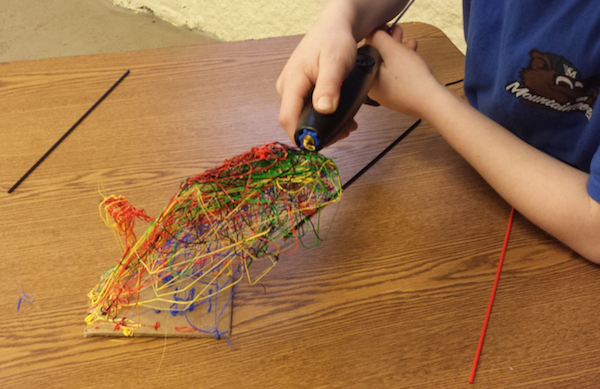
When I got everything down to the library basement yesterday afternoon, there were already some kids waiting. Apparently they’ve been asking for a week or so when the next maker meeting was going to be. Mostly I set them loose with the 3Doodler to keep them out of my hair while I got my printrbot working (all we had was a couple of mac laptops and the ancient version of Repetier that runs on OS X), but I was amazed at what they came up with, and with the complete lack of incident with a bunch of 7-to-11-year-olds handling a toy that happens to have a 220 C nozzle.

Once I got the printer set up, there was the usual hypnotized crowd watching the layers go on and listening to the music of the stepper motors. You could see the wheels turning in one kid’s head as he talked about printing out some of the characters he designs in Cinema 4D. And of course everybody knew about the prosthetic hands (maybe we should print one?).

If we had the resources to run something like this on a weekly or even a daily basis, the kids would find plenty of new stuff to do and build. Some of them are already complaining about not enough things to solder. But along with the crowds of kids there was a distinct lack of adults. Lots of folks who agree that there should be a makerspace in town, and wish they could use the facilities it would provide. Even people who are offering their large empty buildings as a venue. Perhaps, unlike the kids, they just didn’t get the word of mouth or see the right notices.

Posted in going places, making | Tagged , , , | Leave a comment

All hail our eight-armed server

Screen shot 2015-03-24 at 1.23.57 PM

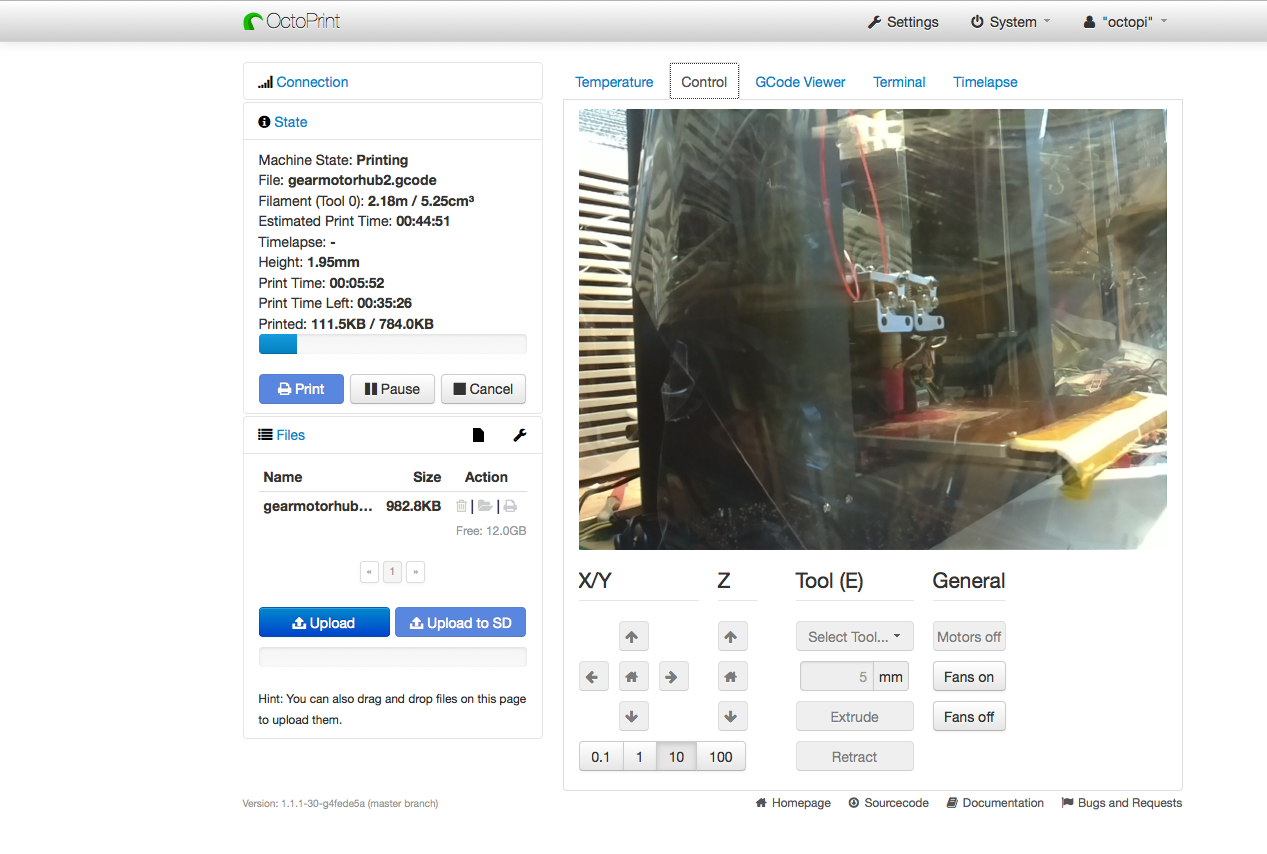
Octoprint rules. I read up on it, downloaded Octopi, flashed an SD card, booted up a pi and configured it, printed a up case and bolted it to a random piece of wood, twiddled a few settings, and here I am upstairs watching something print in the basement. The only hitches were getting Slic3r to behave the way I expected when not run from Repetier and replugging the tiny pcb flex connector on the pi camera.

Oh, and I really want sound. Just by listening, I can tell how a print is going and whether the extruder is having any trouble, and it would be really cool to have that at a distance. (Of course, if I read up there’s probably a plugin for that. The plugin architecture is so simple.) And I want a telephoto for the camera.

But first, I need to get back to the project I was doing when I found out I needed Octoprint in the first place.

Posted in possibly useful | Tagged , | Leave a comment

Sometimes you don’t want to be on the internet

Yesterday I went to a piratebox workshop at Generator. It was a good thing, because although the installation process is fairly straightforward, there are a few places where it’s good to have someone walking you through it. (Yes, it really does take the box that long to reboot. No, the only text editor available on is vi. Turn off your wireless during the installation. Things like that.)

If you haven’t seen it before, piratebox is a really sweet hack for certain portable wifi hotspots. It replaces the usual firmware with Openwrt and then on top of that builds a web server for sharing files, discussion forums, live chat, media streaming… all available only within wifi range of the box. Local, mostly anonymous, unfiltered, all those buzzwords, on a 32-gig flash drive that you can change out whenever you want.

There’s also a version called LibraryBox, which is mostly the same thing, only focused more on delivering information than uploading and chat. It typically comes with a current download of wikipedia and Gutenberg (needs a 64-gig drive), and anything else the librarian wants to put on there. Particularly useful for teaching workshops in places with dicey internet, because you can put everything on the box rather than having all dozen or two participants hammering the same few sites over a tiny connection.

I’m thinking it would also be useful for performance spaces (either permanent or temporary). Folks who like the digital stuff  might have a special reason to attend if some images/sounds/texts/etc would be available (initially at least) only at that place and time.  (Oh, and because connecting to a piratebox cuts you off from the internet at large, people might be more focused on the event even as they continued to play with their phones and tablets.)

Posted in going places, possibly useful | Tagged , , | Leave a comment

Makers at the Statehouse

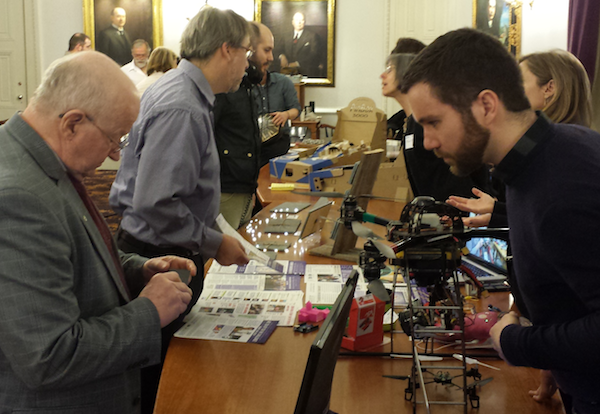
I’d never been on the floor of a legislature before. Heck, I’d never even been inside the Vermont statehouse.  But my friend Lars, who happens to be executive director of Generator in Burlington, and one of his friends from the state economic development agency, and a few state legislators, set up an event so that people in the state government could see the range of cool tech-ish things that makers are doing  in Vermont and keep them in mind.

statehousemakersI got to talk with people doing a bunch of cool things, including the folks from AirShark, who are flying camera drones around buildings  and landscapes and taking pictures that turn into a point cloud that turns into a centimeters-accurate 3D model. And a lady who is using a laser engraver to make stone markers, and a guy who makes tuned drums from the bottoms of propane tanks. And Tyler from Filabot, and Ben and Pete from Cardboard Teck, who just finished up their laser-cut pinball machine…

And as part of all this, to make it official, we trooped into the legislative chamber just at the end of the noon recess, and, after an invocation comparing the legislature facing a revenue shortfall to Gideon facing the Midianites, the reading of the titles of several bills, and a request to move a bill from the Judiciary Committee to the Agriculture Committee, one of the legislators sponsoring the event got up and spoke for a while about the maker movement and what he thought it meant for the state, and then we stood there while everyone applauded us. It was pretty neat, and also sobering. (I also learned that the carpet on the current legislative floor is a precise copy of the original, the records of the pattern having been preserved for almost 200 years. Talk about continuity.)

I was there in my capacity as Guy with Cool Little Toys, which was a little hard for some of the state government people to grasp (no immediate business plan or job impact), but I had a good talk with Mara Siegel — who also got a Circuit Scribe kit but has been procrastinating on playing with it — about getting cheap LEDs in bulk from surplus sites. We figured that a conductive-ink pen, a reel of surplus LEDs and some glue would let a library make light-up crafts whenever they wanted for about $50. Also conversations with a bunch of people who thought it was a great idea for Montpelier to have a maker space, all willing to help, and all looking for someone to lead the effort.

statehousekthOh, and people flocked to the 3Doodler. In a room full of mostly straightforward technical explanations, how could anyone resist the chance to write their name or make a tripod in colored plastic?

Posted in going places | Tagged , , , , , | Leave a comment

Nasty things, adventures

When my freshman-year college roommate was in medical school, he told me that surgeons were trained to say “There!” instead of “Oops” when they made a mistake like cutting the wrong organ, so as not to panic everyone around them.

There. As far as I can tell, my Metal Plus is back in commission, minus one hot end. I would like to thank Lincomatic for writing a post with most of the information needed to fix things, and for making a selection of At90usb1286 bootloaders available for download, and the folks who wrote the reprap wiki page on the Printrboard, who supplied crucial additional information about beating Ubuntu into submission so that the bootloader and the host computer could actually talk to each other. And of course Adafruit for designing an AVRisp that. Just. Works.

My experience may be useful to anyone else who manages to bork their board in just this way. I found that the fuse settings on the reprap wiki page ultimately worked; the ones on the lincomatic page didn’t, although they might for someone else. Also: the CDC bootloader  reliably stopped working exactly halfway through uploading the main firmware. The DFU bootloader worked, even though dfu-programmer is a slightly less convenient program to use. I probably should have written a shell script to automate the process of removing the usbACM driver and (re)installing the generic USB driver, but a shell with an up-arrow for history works about as well (and hopefully I won’t be doing this that often).

Oh, and once I got the printrbot firmware reloaded, it identified itself to the lsusb command as a Teensyduino serial device, so maybe it’s no surprise that the Teensy loader extension attached to my Arduino software thought it was OK to talk to. (I also have a theory about why all this was able to happen even though Repetier was controlling the printer at the time. Imagine a program so polite that for each read and write to a device, it opens the necessary port, does its business, and then closes it again. Nah…) So it looks as if there’s an Octoprint server in my future too.

Posted in possibly useful, probably boring | Tagged , , | 1 Comment

And this is why you make really sure which USB port you’re writing to

(Update: Mostly fixed. If reflashing a Printrboard from the bootloader on up interests you, see the next post.)

I was getting ready to print a nice big dragon on my Printrbot, but I knew it was going to take several hours, so I also got ready to port a lidar project I’ve been working on from Arduino to Teensy (same development environment, much smaller board, a few different pins).

I wired things up, opened the test program for the lidar (which just sends the measured distance to the serial monitor) and prepared to compile and send. ACM1 or ACM0? I picked ACM0 and hit the upload button, got a “Reboot OK” message. Then opened the serial monitor and read a line that started with “Marlin” and ended with a couple of extruder temperatures. I would have thought that Repetier having the port open to read data and write command would stop another program from jumping in, but nope.

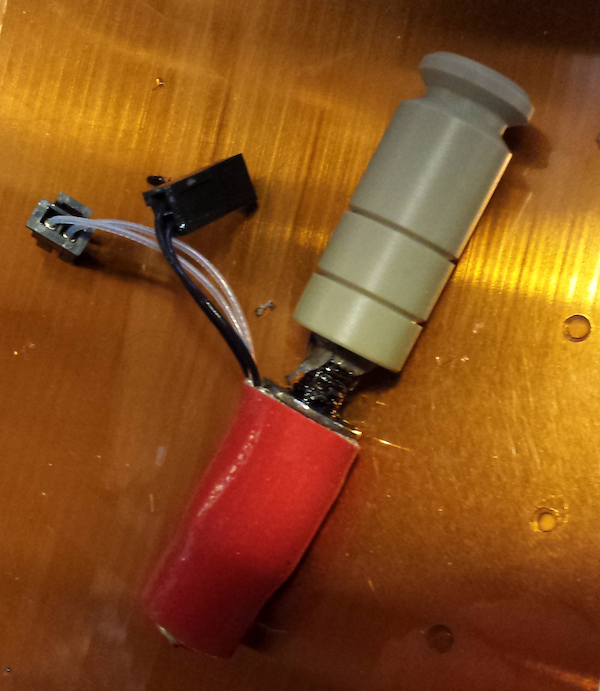
meltedhotendOops. It got worse. Neither Repetier nor Cura could connect to the printer any more, even after several power cycles. So I went upstairs to deal with some other things for a few minutes, and when I came back there was a decidedly acrid smell in the air. Whatever I uploaded to the printer had cranked the heat on the #2 extruder up to maximum and left it there. Globs of black plastic, hot end hanging in midair, all that fun stuff. I figure maybe I can salvage the nozzle.

It’s not clear whether I can salvage the main board, though. Whatever code it was or wasn’t running appears to have bricked the processor: it doesn’t appear as a USB device anymore, the Atmel Flip program for burning new code doesn’t seem to work, neither does the open-source alternative, dfu-programmer. (Which makes a little sense, considering that whatever code may have made it up there was for a substantially different CPU with  a quarter the memory and different pinouts.) Tomorrow I’m going to try and reflash using the old-school six-pin ICSP header.

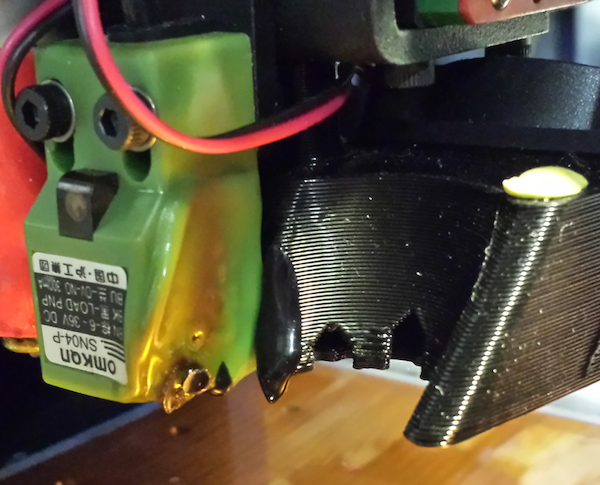
meltedsensorAfter that, we’ll see how much of the rest of the machine is salvageable. The fan shroud on that side is only a little melted, same with the inductive Z sensor.

Oh, and at least I don’t have to ponder whether to get a regular hot-end to replace the toasted one or to wait until the all-metal version comes through — now they’re both on backorder.

Posted in things that don't work | Tagged , , , | 5 Comments

Arduinos need more power pins

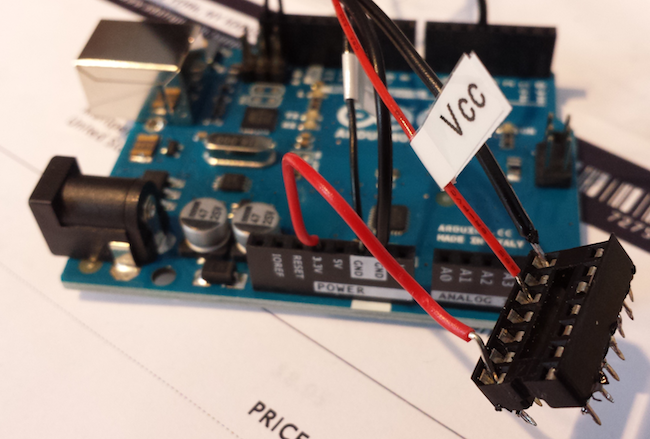
And ground too. This morning I was fresh out of available breadboards. So I made my own power distribution strip out of an IC socket that was lying around on the workbench.  Took a couple of the zillion clipped-off component leads and soldered one to each side of the pins and that was it. Ugly, but it works. And way cheaper than buying the solderless-breadboard strips.

socketstrip

Posted in possibly useful | Tagged , | Leave a comment

It’s all in the background.

When I was in college, I worked in a laser lab one summer, for a visiting professor who was doing research on metal-vapor lasers. The first half-dozen times we turned his apparatus on, all it did was make the grad student at the next optical slab over really mad. Because the apparatus was using a big honking RF generator to ionize the metal vapor and prepare it to respond to a pumping laser, and there was enough energy leakage bouncing around the lab to trip the breakers on all the grad student’s power supplies.

Yes, our equipment was grounded. But it wasn’t really grounded. I spent the next couple weeks helping to make perforated-steel enclosures for all our RF stuff, connected every few inches to a the building foundation by copper-braid straps the size of your thumb. I have come to realize since then that this probably wasn’t the best way to get rid of the RF, but at least the breakers stopped tripping.

We went on to do some measurements and found really remarkable results. The metal vapor was showing gains of 30-40% in one pass of pumping light through the tube. This was going to be really big and important. Then summer was over  and it was time for me to go back to classes.

A few months later, I asked the professor who ran the lab what had become of the fantastic metal-vapor laser experiment. Garbage, he told me. It turned out that when you turned the RF generator on, there was still enough RF interference leaking around that it acted as an additional power source for the pumping laser, and all the measurements of increased output had been due to that.

***

So I’ve been working on an off to build a DLP printer using a regular projector with a mercury lamp, and I almost had it going (my test piece was sticking to the bottom of the vat instead of to the stage, as they do). Then I left a vat on the machine for a couple minutes with no image going through, and found that a bunch of the resin had started curing anyway because of stray UV bouncing around. Not good.

Quickly I got some tape and aluminum foil and covered all the light leaks, so that only light from the lens would get through. Improved the image quality quite a bit. And the machine stopped working at all. Instead of exposure times of a few seconds per layer, even exposures of a minute per layer weren’t doing anything. 10 minutes of continuous exposure, nothing.

But wait. I’d been getting images of what was being projected. Images stuck to the floor of the vat, sure, but still little pieces of cured plastic in the right shapes. How could that be? My best guesses are that either the light from the projector managed to piggyback on the UV light leaking from the lamp, or that the projector (remember, this is a couple thousand lumens delivered to an area a few inches across) was heating up the resin where the image was and making it just a little bit more responsive to the UV. Because I took apart the lamp and there’s a nice thick glass UV filter right across the front.

So now I’m at a crossroads — do I redo the optical path so that some UV gets through after all, or do I carefully open up the light leaks again and see if I can make use of the background instead of suppressing it?

Posted in things that don't work | Tagged , , | Leave a comment

What does that button do

You know the adage that documentation is to let other people understand how and why you did something, including the other person that is you three months from now?

If I had either documented the steps I took to get one of my long-running projects to an almost-working state, or just written “DO NOT TURN THIS OFF!” on a post-it by the power supply, I wouldn’t have learned an important lesson today.

So I’ve been working on a widget that includes a projector, and the projector I got uses a VGA connector, and running the late-middle-aged linux box in the basement two-headed with analog video would have required another video card and all the interesting configuration that goes with it.

Instead, I thought “Hey! I’ve got got a Via mini-itx board from that digital picture frame project 12 years ago [it’s so old I can’t even find a link to the specs or a review] and it ran debian back then; why don’t I use that and just connect to it remotely?” So a few months back, I hooked it up, attached a new power supply, patched in a CD drive so I could reinstall the operating system to a capacious 30-gig hard disk, and set up XVNC (which took some doing, because parts of the network in the basement really want to think they’re running on IPv6 and way too much of the software involved insists that only IPv4 addresses will do, and the Via makes a Raspberry Pi look like a speed demon).

So once I’d done that, I could run the projector from the Via hardware, but have keystrokes and mouse movements on my main machine control what was being displayed. And I left the Via powered up (it draws a whole 15 watts or so) rather than take the time to debug the startup scripts what would let me just boot it up into a remotely-controllable state that other computers on the network could find.

I left it powered up for months while I did holiday stuff and worked on other projects and other parts of this project, and then, a few days ago I was seized by an urge to save electricity. So this morning and early afternoon I got to go through the whole process of disconnecting the projector, connecting a spare monitor, rebooting the Via (there are a couple of jumper wires plugged into a header for just that purpose, since it won’t just turn on when power is applied), finding out its new IP address, logging into it remotely…

At one point I even had a remote session from Sampo, my main machine, that was open to a desktop on Frame (the Via) where I had opened a remote desktop back to Sampo. It wasn’t quite as slow as you would think. OK, maybe it was.

So next time I do a project like this, I think I’m going to just get a whole new main computer that can do the two-display thing without all the headaches. But if I do that, I won’t be able to take it anywhere. Maybe a Pi and start retiring all the display devices that don’t do HDMI. Hmm, what was that lesson I learned?

Posted in making, probably boring | Tagged | Leave a comment