A Makerspace is a Business

Last night I went to the Generator member meeting. I talked with some cool people about projects, but the main agenda was listening to the staff and board telling us how things were going and where they might go next. Things like “If nothing changes, we have enough money in the bank to keep running until May.” Or “Have you ever been in an industrial accident?”

Meetings like this one are an important reminder. Underneath the cool tech, the open source this and that, the collaborative culture of teaching and learning and making, there’s still a lot of hard work and an unavoidable need for cash flow. We applauded the people who had gotten the city to let Generator have a space for below-market rent (but still not what ordinary mortals would call cheap). Who supervised the construction — to code — and sweet-talked various institutions into supplying seed money, equipment, student interns. Who keep the users of all the cool tools from killing themselves or one another.

Some things can be informal, others can’t. So apparently the certification on tools will be more rigorous (what, I can’t just pick up the welder and start making sparks?!) and there will be a database of who is certified on what and little cards to swipe and maybe even chargebacks for the $300 a month or so that it costs to buy filters for the laser cutter. And reminders to keep the place clean, because there’s no money for a janitor. It’s almost as if the enterprise is moving out of startup mode. A sobering thought for a bunch of hackers.

I was a little taken aback by the focus on safety, but then it is the kind of thing that home hackers tend to forget. As the toys get more powerful  (especially in the wood and metal shop sections) and potentially more capable of producing strongly toxic fumes and dust, the risks get higher. Someone getting injured would be a Really Bad Thing for a makerspace, both financially and as publicity. Which is probably important for someone like me to remember, because usually I don’t consider a project fully underway until I’ve nicked or burned or sprained myself somehow.

And now back to trying to figure out how to 3D-print a vacuum assist system for a laser cutter. Nothing could possibly go wrong with that.
Posted in going places, making | Tagged , | Leave a comment

The Shapeoko 2 is not that hard to build

shape2

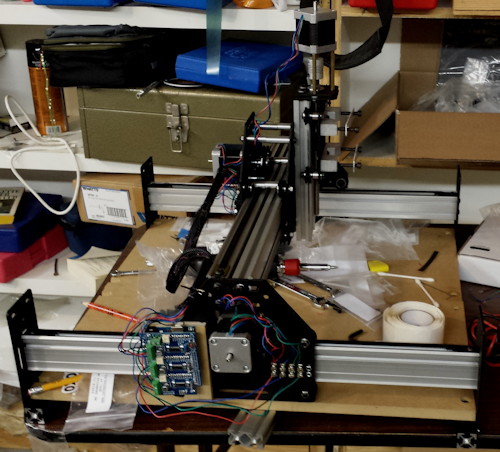
I’ve been working on this in odd hours for the last month or so. But. Next time Read The ^#@^% Directions All The Way Through Before Starting The Build.

No, really. I’ve had to go back a few times and take something apart because I thought I knew what I was doing. I even had to solder some wires back together because it seemed so obvious that I should snip them short where they came out of the stepper, connect to a terminal block (modularity!) and then wire from there. Except not quite enough wire. (Ooh, maybe I could use that roll of rigid jacketed stuff that’s no good for anything else, since that’s the one run on the entire project the doesn’t need to flex endlessly. Nah…)

I mounted the controller on the Y axis, not so much because it’s cool, but because it simplifies the cable bundling. The instructions warn that it’s hard to attach the arduino and the grblshield to the end plate once you’ve got everything assembled, but it really isn’t. I just nipped out to my pile of scrap plywood and cut a tiny piece that I screwed to the plate. And then I screwed the arduino to the plywood. If I get some time and motivation, I’ll make a 3-D printable version of the scrap piece, complete with cutouts for bolt heads and  undersized circuit-board mounting holes.

The 2 is a lot more rigid than the first Shapeoko, but it’s still pretty flexible. I’ll be able to take some of that up by adjusting the v-wheels and tightening a few nuts and bolts some more, but ultimately there’s only so much you can do with delrin and extruded aluminum. (I think the first Bridgeport mill I ever got near in college had a solid column  pretty much the same cross-section as this whole machine.) And it’s probably a good thing that the whole design flexes, because otherwise if you tried to cut too hard something vital would just break.

Oh, and meanwhile thanks so much to the folks at GRBL. The new version has pretty much all the bits I want, especially the separate speeds and accelerations for different axes. That will make a huge difference to the shapeoko (where the z-axis acceleration has never been what you would call spritely).


Posted in making, possibly useful | Tagged , | Leave a comment

Left hand, meet right hand

You would think that in a small town everyone would know what everyone else is doing. Well, they do, but not in enough detail to be of any use to one another. This morning I heard about the fourth (maybe fifth, depending on how you count) person/group with a site where they want to set up a makerspace in town.

Number of those people I’ve met: two. Number I’ve talked to past the first five minutes of “Hey, that sounds like a great idea, let’s do something about it”:  …  you guessed it.

Maybe I’m just used to things that happen on Internet Time rather than hinterlands time.

Posted in making | Tagged , | Leave a comment

A visit with Tyler

One morning last week I arrived at at Local64 to find a couple of spools of 3D-printer filament on my desk, one bright yellow, the other black with a label that read “carbon fiber”. Stuck on top a note saying “From Filabot. Call Tyler” and a phone number.

Heck yes. Tyler McNaney’s startup makes extruders you can use to produce your own filament from pellets or ground-up plastic trash, grinders for said plastic trashspecialty filaments such as ABS mixed with carbon nanotubes and I’m not sure what else. We’d met at a couple of maker events, and I’d admired his machines, even though I don’t print nearly enough to need one yet. And they’re in my town. Visit and see what they’re working on? Sure.

Vermont street grids being what they are, I got directions: Out past the lumber yard, hang a right at the VFW, past the big brown building that used to be a granite shed and through the big main door of another former granite shed… I knocked, and the guy at the workbench took a moment to shout up a ladder: “Tyler, you’ve got a visitor!”

Tyler  shows off Filabot’s new (surplus) milling machines, picked up for barely more than the cost of transport, the production line (there’s the guy who shouted, wiring up the assembled filament extruders, the parts bins, the station where the new guy will soon be welding parts together) the shelves of finished inventory. In another section a couple of filabots produce filament for sale. Tyler is proud of the web interface for the bots, so that he can start or stop production from home; I’m charmed by the the simple control for the take-up reels: every time the loop of newly extruded filament sags enough to trigger an optical sensor, a gearmotor inches the big spool around another inch or two.

We step out into the main granite-shed space, where Tyler has plans. He wants to build a printer big enough to fab a kayak in one piece, then paddle it down the river just outside. Maybe fab a small building. The shed is big enough, and nestled beneath the roof beams is the old gantry hoist, still working, with rails running the length of the shed. “You’ve got X, Y and Z already there, he muses.”


Posted in going places, making | Tagged , | Leave a comment

The accidental makerspace

I have a bad Kickstarter habit. If it’s maker-related,  I want it. I missed out on the microcontroller that runs Python out of the box, but I’ve got oodles of tiny wireless boards — bluetooth and wifi oh my. And a low-end CNC machine. And a rotational casting machine. And a thermoformer. I would have gotten a laser etcher except I’m bound and determined to build my own. Same with 3D printers: I have so many great ideas it would be a shame to back one that’s already built. But I’ve got structural parts and a hot end for my next extruder, and some whizzy new filament coming, and I’m not sure what all else.

All of this has cost me about as much as it would if I had a latte every day for the same length of time. (It’s a good thing I can’t tell the difference between the fancy stuff and regular old coffee-with-milk.) Which brings us back to a point about makerspaces that came up repeatedly at the e21 conference a few weeks ago: it’s not so much about the stuff as it is about the people.

In the context of what people’s time is worth, pretty much all the toys you could want are cheap. (OK, maybe not the full-size industrial versions, which all seem to run north of a hundred grand, but the kind you would want for learning the technology, playing with ideas and making your first few sets of prototypes.) It’s the time, energy and collaboration that are at a premium.

Posted in possibly useful | Tagged , | Leave a comment

This is going to make Arduino workshops much easier

Cloud-based arduino editor and programmer. Now I won’t have to tell people to download 100 MB of development environment, make sure they have all the right libraries installed, and so on and so forth just so they can get an LED to blink. On the other hand, it means they don’t get to use Ardublock until some smart cookie figures out how to port it to a browser (which should be relatively simple, since Ardublock is just a bunch of java code that plays with little chunks of XML and delivers Arduino code to a local editor. So the equivalent in web-based programming should be simple enough. See also Scratch.)

Browser-based development environments are becoming way more common (it’s not just arduino but also Beaglebone Black and Spark Core) which is probably a good thing, because even if you’re a codehead it’s a pain keeping all your tools and libraries and random little bits of useful crap up to date and consistent across multiple machines. And pretty much everyone uses more than one computer. Of course it also means that if some machine on the other side of the world decides to have a sneezing fit you can’t get any work done, but that seems to be becoming standard these days.

The Beaglebone Black case is particularly interesting for me, by the way, because cloud9, the browser-based programming environment you’re using there (if you do) is actually being served by the tiny little computer itself. You could attach a keyboard, mouse and screen to the Beaglebone directly, and then open up a bunch of windows to program it, but it’s just as easy to let the BBB run its web server with a bunch of accessories that let you program in a browser window. It’s as if the browser has become the primary metaphor for everything people do on computers, even programming or something.


Posted in making, possibly useful | Tagged , , | Leave a comment

The internet of things is really seductive.

So this morning after the spark cannon and the van de graff and the tesla coil I went to the internet of things workshop. It was fun. And dead easy. The guys from Sparkfun were showing off their new data service, which lets you plunk random data up to a stream (visible to the world, writable only by you unless you give someone else your private key or you use an http session and it gets sniffed, free) and then snarf it down again. One line of code to frame a post request, one line to frame the get (and a little more to parse it). Sweet. simple. Open source

This would make it easy for me to forget that I’m opposed to Internet of Things in principle until the security and privacy issues get sorted out and the lion lies down with the lamb. I’ll probably start using it in projects, at least for collecting information that isn’t particularly private anyway.

Even more interesting for me was that they started demonstrating their IOT stuff by giving us all the files we needed via a LibraryBox. The idea of a wifi hotspot for distributing information that isn’t connected to the internet at large really appeals to me. (And appealed to a lot of the teachers there, who daily face the question of how to let kids use computers for their lessons without having them all go off to IMs and random surfing.)

I feel sort of bad about wanting to make walled gardens and cultivate them, but sometimes I think that will be the right thing to do. There’s a lot of stuff that’s fun and useful to hand around using IP addresses and internet-style tools that really doesn’t need to go out on public networks and face all the issues involved in securing it.  (And yes, I know private networks aren’t necessarily all that safe either.)

Can’t wait to go home and start hooking some of this stuff up. I’m gonna need some more sensors…

Posted in going places, making | Leave a comment

How many librarians are in the witness protection program?

“They hired a new librarian and she got rid of all the books.” That was the gossip around town shortly after she arrived, said one of my tablemates at lunch. Books about our perennial adversary the Soviet Union, about how Man was going to live in Space, about how lasers were going to transform our lives. And children were going to come home from school and have their snacks heated by a miraculous new device called a microwave oven. A good school library has to throw books out. And bring in new things that aren’t necessarily books.

If you think about libraries as repositories and curators of learning rather than places where people go to get books, then it makes perfect sense that the Vermont Department of libraries should sponsor a conference with such sessions as “Citizen Science”, “Scratch”or “Hacking Sketchup with Ruby”. Or that librarians should be hosting makerspaces and organizing classes on robotics or squishy circuits. And making plans to stock microcontroller kits as part of their lending inventory. They are, according to Sparkfun’s Jeff Branson, teaching people to write as well as to read.

This is not your usual hackercon. Almost everyone here seems to have a story of how co-workers and acquaintances look at them a little sideways for being interested in this kind of stuff. Almost all of them are women. It’s a refreshing change from the more conventional vibe in the technical community, where there’s sometimes just a little too much background whiff of testosterone. (Albeit at the morning plenary there was plenty of time for the first three men who spoke and only a few minutes for the woman who went last. And gave them just a bit of heck for it.)

And now it’s time to nip over to the basement of the next building and join everyone playing with all the toys presented in the sessions and workshops. I can’t wait to see if Ardublock is as ready for prime time as my 9-year-old thinks it is.

(About the linkbait: At registration, conference organizer Mara Siegel  — of whom one can hardly avoid using the term “irrepressible” — was urging everyone to sign their photo releases, then stopped for a moment to wonder aloud how many librarians had previously led criminal careers that might endanger them if they were identified in a picture. No one standing around the desk seemed quite sure.)


Posted in going places | Tagged , | Leave a comment

This is a great time to be doing stupid things

Ten years ago, I built an ostensibly cutting-edge mobile robot from a kit. It cost close to a thousand dollars, required an attached laptop computer to operate it, and it never really worked. Sure, it could zip back and forth and make noises, but the simple task I set for it – recognizing a can of soda, picking the can up with its gripper and then bringing it to me – was an exasperating near miss. It could recognize the can every now and then, maybe head in its general direction. Grabbing: nope, unless I put the can right inside the gripper. And all the software for controlling the thing was firmly proprietary, so no hope of making any tweaks the manufacturer hadn’t anticipated. (Why yes, they did stop supporting it a few years later. Thanks for asking.)

Today, I could build that same robot for well under $100, including the computer to control it. It would be about the same size as a one of those nice solid books about Python or Ruby or Drupal, instead of bigger than a milk crate. It would run open-source computer vision software. If I wanted to save a few dollars, instead of buying a servo-operated gripper from one of a dozen or more robot-part sites, I could just 3D-print or laser-cut my own at the nearest makerspace. I could mount a sensor right on the gripper to measure the distance to the can to a fraction of a centimeter, and it would cost about five bucks. And then it could tweet to the entire universe: “Hey, I just brought Paul a soda can.”

No, I don’t have any pressing need for a bot to bring me soda cans. But I might do it just because now a rank amateur like me can. After 25 years of cool stuff being just around the corner, maybe available technology is finally catching up.

Posted in making | Tagged , | Leave a comment