Cupcake Half Aria

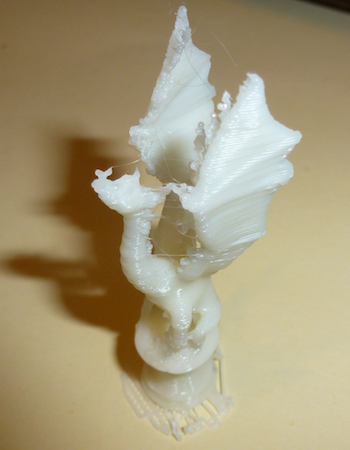
Everyone seems to be printing Aria these days, and it has a high rating for printability, so I figured on putting it to the acid test: my old cupcake.  Darned if it didn’t work OK. I had to scale it down to half size to get inside the build envelope (might have managed with 2/3), but 40 minutes after I sliced it with my standard ABS profile and clicked “Build”, there it was.

AriaAfter AriaBefore

Pretty stringy, which is standard for the cupcake (because it has that huge column of 3mm filament between the drive gear and the hot end, so retraction doesn’t do much), but also not that hard to clean up into not-completely-ghastly condition. Maybe thinner layers?

Someday I want to print one at huge scale and negligible infill so I can put lights inside…

Posted in toys | Tagged | Leave a comment

Reducing cognitive load

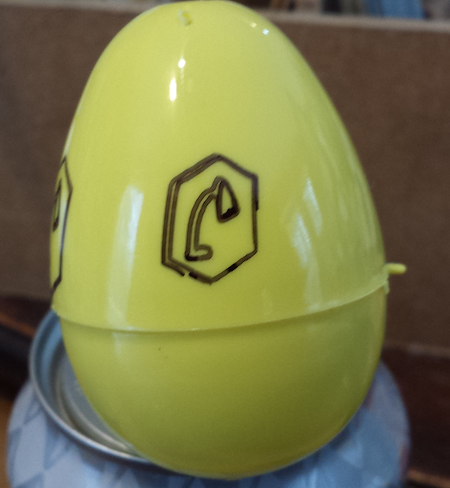
L64eggFor christmas, my delightful spouse got me an Eggbot kit. And since one of the resolutions this new year is to build kits instead of just getting them, putting them on a shelf in the basement and dreaming about how cool they would be…

The kit goes together very nicely (if anything, the instructions are a little too detailed) and every time I thought a part might be missing, it turned out that the part had simply slid or rolled under one of the internal seams in the cardboard package. And the Inkscape plugin works beautifully (and I am so happy that there is finally a new released version of Inkscape for macs that has all the features everyone else has been playing with for years).

But back to cognitive load. When I first opened the box and saw that all the structural parts for the eggbot were made from extra-thick circuit-board material, I thought “Gee, isn’t that a bit pretentious and wasteful? Why couldn’t they have injection-molded it or had it laser cut or something?” But after putting the thing together I realized that it wasn’t pretentious or wasteful; it was a choice that relieved the designers of a long list of other finicky decisions. What other material can you order so easily, cut to arbitrary shapes, with whatever holes you want, printed with dimensionally accurate graphics? Whose material properties are known and don’t have to be tested or subjected to careful analysis. Oh, and where you can include a metal heat sink essentially for free. Sure, it’s more expensive in high volume, but it’s cheaper upfront, and eggbot kits aren’t exactly a price-sensitive commodity product. So you’re saving on the most precious maker resource of all: the designers’ time and ability to move on to newer and more interesting projects.

(That lamp-in-a-hexagon, btw, is the logo of Local 64, the co-working space downtown where I rent  half an office so I can pick the brains of lots of people smarter than me.)

Posted in making, toys | Tagged , | Leave a comment

Future-proofing the workbench

thirdhand
I think the workbench was one of the first things I built in the basement after we moved in 14 years ago, out of leftover flooring from the previous place. It’s long since become just one more flat surface punctuated by vises, and until this week the rows of 3/4″holes I drilled in it for bench dogs way back when were mostly an annoying way to lose small items.

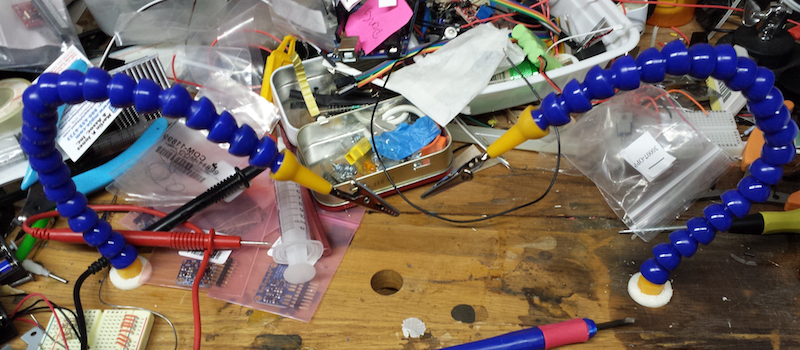
But by some chance of avarice a pile of articulated coolant pipes, aka “third hand” arms, showed up on my doorstep this holiday season. A couple of measurements and the world’s shortest openscad design session later, I was printing up a collar to mate the pipe fitting on the end of the arms to the dog holes. Then I mashed the alligator clips from my existing (much loved, much hated) third hand tool so they would fit into the nozzles, and presto.

I like two things about this new setup: it moves a lot when you want it to, and it doesn’t move when you don’t want it to. And potentially as many arms as I want. As soon as I can fake up a clip to hold solder and a frame to hold a decent-size magnifier I will be set. (Also note that most of the cheapjack p0rtable work stands from the usual box-store suspects come with similar but not quite identically-sized holes.)

Posted in making, possibly useful | Tagged , , | Leave a comment

Like kids in a candy store

This morning I had a short meeting with the Cardboard Teck Instantute (aka Ben Matchstick and Pete Talbot), who have a residency at Generator next month.  These guys are so good at building toys, games, vehicles, whatever entirely out of recycled cardboard plus a few pieces of wire and rubber band that they’d never really needed to learn about arduinos and servos and IR sensors and LEDs and all the other electronic bits that geeks like me take for granted.

So I showed them the simplest possible thing: three extra lines pasted into the standard arduino servo sweep example that make the servo wave its little arm back and forth only when a PIR sensor has detected someone moving in front of it.  “We could do things with that,” they both said. Then I gave them a quick tutorial on the structure of basic arduino programs, where the stuff you want to do once  at the beginning happens in the setup function, and the stuff you want to do forever happens in the loop. And each time through the loop you can check your sensors and count how many times something interesting has happened, and then trigger some action when that count reaches the right level.

And then I started telling them about all the other kinds of sensors and displays you could stuff into a cardboard chassis — that’s about where they started talking about striking a balance between cardboard low-tech and semiconductor high tech.

At Generator there are piles of arduino-compatible parts that members can borrow for prototyping, and a laser cutter that’s way more precise and reliable than an exacto knife following hand-drawn templates. This could be really cool.

Posted in making, possibly useful, toys | Tagged , , , , | Leave a comment

This year with less risk of exploding batteries

ikealight1So there was this spot in our living room that was just perfect for an Ikea lamp. The only problem was that we didn’t want to pay an electrician to put in a new electrical line, or a sheetrock/painter type to repair the damage that would be done by the electrician.

Instead, we mounted the body of the lamp where it was supposed to go, and I got busy with the soldering iron and the 3D printer. I printed a piece that screws into the lamp’s light socket and holds

  •  a big honking 14.4V lithium battery,
  • a couple feet of 12-volt “warm white” LED tape and
  • a perma-proto board with a latching rf switch, a mosfet and two voltage regulators, to feed the switch and the light string.

lightinterior

A battery that fits in roughly the same space as an incandescent bulb turns out to hold enough energy for about 20 hours of light (at 410 milliamps for the LEDs and maybe 50 for the regulators and everything else). So swapping in a new battery every three or four nights should be fine, right? Unless you have holiday guests who stay up all night reading and forget to turn the light off…

After the second time I had to nurse a battery back to life by lying to the charger about what kind it was (there’s this thing called an undervoltage warning, which basically means “your battery is too deeply discharged to recharge safely using a standard charging cycle”) and spending a couple days in really low trickle charge, I decided that my circuit needed some kind of low-battery warning.

Well, that seems pretty easy: wire up a Tiny85, put in a voltage divider to read the battery voltage with the analog-to-digital converter, write some code to blink a warning LED when it goes too low, or maybe even use a pin from the Tiny to power the rf switch and hold it high only so long as the battery is good, or maybe a big power transistor to turn the whole circuit off, because even the voltage regulators will eventually drain the battery dead. If there’s not enough space on the protoboard I can just solder on a daughtercard.

Or maybe I’ll do that on the next lamp I build. This time I just coughed up the three bucks to add a low-battery-warning board to an order of servos and stuff from Hobby King. Yes, those piezo buzzers are incredibly loud, but not so much when you squirt a dollop of household caulk into them.

Posted in making, possibly useful, probably boring | Tagged , , | Leave a comment

The encrustation of the analog on the digital

If Henri Bergson had been writing around the turn of the millennium, he would have talked about abstraction violations. In his time, it was about living beings acting like mechanisms. For me this weekend, it was about digital devices acting analog.

I love my Blinkytape, so when I got email announcing that there was a special run of addressable christmas-tree lights with the same built-in arduino-compatible controller, my response was pretty much “Shut up and take my money.”

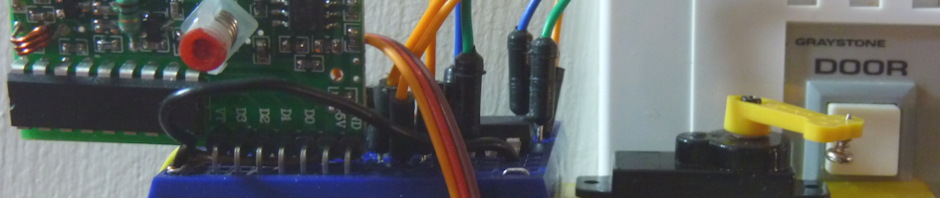
A couple of boxes arrived from China way sooner than I had imagined, and I got the strings out and powered them up and enjoyed the glorious color-chaser factory demo for a while. Then I took one over to my mac, plugged it into a USB hub, and got ready to code some patterns that wouldn’t make my spouse claw her eyes out if they were on a tree.

Nothing doing. The string did its factory demo thing just fine, but the arduino IDE could not program it. Sometimes it thought that the controller on the other end wasn’t emulating a Leonardo. Sometimes it thought another program was already in control of that USB port. Sometimes it thought “resource busy”, and sometimes it even thought the program had uploaded correctly, but the string of lights didn’t do anything different.  I shut down all my other programs, restarted the computer, got code transferred. Once.

Then I tried PatternPaint, the Processing-based app that Blinkinlabs makes for doing lightpainting-style animations. Mirabile dictu! It worked! So maybe it was just something weird about my mac’s USB handling? Macs are known to have USB problems with arduinos, after all. I headed for the Linux box in the basement.

More nothing. Sometimes /dev/ttyACM1 was there to write to, but no Leonardo on the other end, sometimes it wasn’t there at all (even though the string was still doggedly running the last pattern I had managed to put on it).

I fired off an email query to the company, just to get things started, and then went to check if maybe I only had one defective string. The second one was even worse: it wouldn’t program (but would talk to PatternPaint) but apparently the last 6 LEDs weren’t even connected, because they wouldn’t light at all.  More useless troubleshooting, surprisingly quick answer from one of the Blinkinlabs folks, who offered a solid list of questions, additional diagnostic tips and possible fixes.

Then I wondered whether it might somehow be my hub, which was daisychained from another hub and might somehow be producing some kind of signal weirdness. But no, when I plugged an Uno into another port on the same hub it programmed just fine. (By now, some of you are wondering when I will get to the punchline.)

About 5 hours after starting down the rabbit hole, I plugged the string of blinky LEDs into the hub closest to my mac. No problem. I had code zipping right down and pleasantly staid red-and-green fades lighting up my room a minute or two later. Oh, and those 6 dead LEDs at the end of the second string? They were working fine.

The documentation warns you that if your hub is underpowered the product may not work (those LEDs would gladly draw an amp and a half at full intensity, after all). But it didn’t say anything about turning into a chimerical beast that works with some pieces of software and not others. (Now it will. Those guys are fast.) I can only imagine the knife-edge of marginal voltage levels that let the controller respond the way it did. (Oh, and yes, I tried timing the upload so it would happen when the LEDs were dark. Also no dice.)

After the strings started working, I did something else stupid: I’d been using one of those wimpy little narrow-gauge micro-USB cables that happened to be handy, and I decided to see what would happen if I switched to the big, thick, solid cable the strings shipped with. Maybe that would have a lower voltage drop and pass enough current for the controller to work properly. Maybe instead my keyboard would stop working. Turned out that the thicker conductors let the LEDs draw more more current and stress the hub’s power supply that much more.

Once I talked with an engineering-professor acquaintance told me the story of a student who couldn’t understand why an op-amp circuit with a gain of 20 and a 5-volt supply voltage couldn’t amplify a 300-millivolt input signal up to the 6 volts the equation said you were supposed to get. We both chuckled knowingly. Now you can chuckle at me.
Posted in probably boring, things that don't work | Tagged , , , | Leave a comment

I am amazed that this works

it glows!

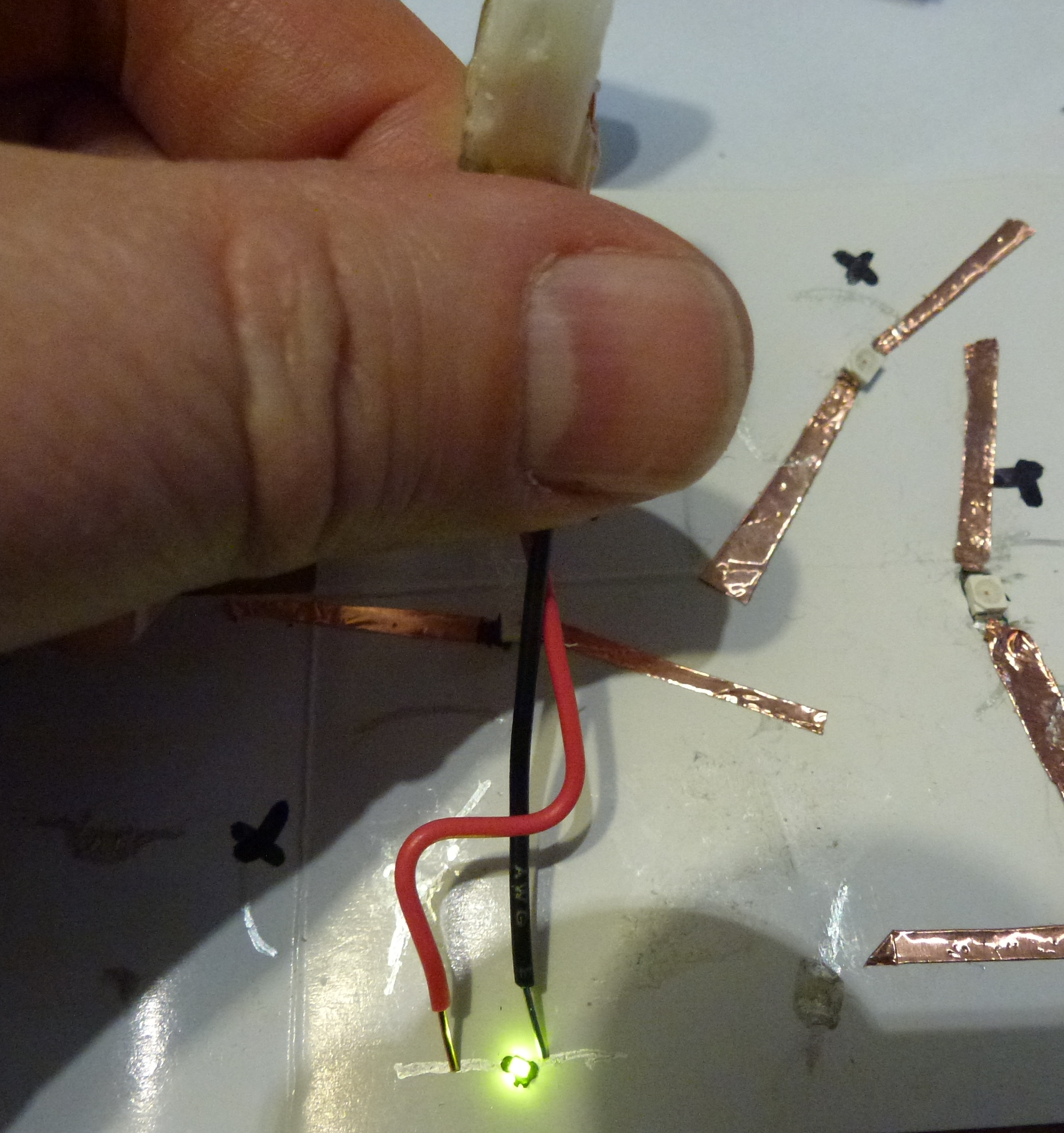
I knew those clip-on magnifiers were good for something other than soldering. That’s an 0603 surface mount LED, held down by wire glue. The traces are silver conductive ink, and those huge-looking red and black conductors are 22-gauge hookup wire. Here’s a wider view:

0603establishingI like the idea of being able to work in this kind of scale for cards or origami or wearables, because with 0603 (or even 0402 for the really deft-fingered) it becomes easier to make stuff where the LEDs support the design, rather than where the point of the design is that it has LEDs in it. Tiny batteries and SOIC processor package here we come…

Posted in making, possibly useful, toys | Tagged , , | Leave a comment

A dumb but nice thing I did

Here’s what I like about having a 3D printer in the basement. Tonight the 9-year-old had a friend over, and we all got some pizza, and on the pizza were a couple of those little legged-spacer things that keep the cardboard box top from sinking down into the cheese and sauce. Both 9-year-olds thought they were cool and took them to play with, and the 6-year-old was miserable.

So while the kids were upstairs watching Chicken Run and eating popcorn, I nipped down to the basement and fired up the Cupcake with a quick sketch from Openscad. Half an hour of printing time later, there was another pizza topper. I told the 6-year-old to be gentle with it, because it was the only one in the world. pizza3

Posted in making, toys | Tagged , , | Leave a comment

An unintended consequence of wire glue’s high resistance

In my previous piece about playing with copper tape and wire glue and silver-ink pen, I was having trouble figuring out a way to hold a surface-mount LED down and get it electrically connected at the same time. Mashing copper-foil tape onto the sides of the LED works, but it’s hard work. Gluing the LED down and then attaching foil or drawing on a silver-ink connection doesn’t really work reliably at all.

So I did some more experiments and found a) that drawing the silver-ink line first, then putting down a dot of wire glue at each contact point and dropping the LED in the middle works just fine once the glue dries. And b) doing the same thing with copper-foil tape works fine as well.

Which brings me to c) by way of a little basic electronics: an LED in the conductive, light-emitting state does not have any resistance. It has a voltage drop across it, but once you’ve got that much voltage or more across it, it will just suck down as much current as you’ve got. Wire glue, on the other hand, has quite a bit of resistance: maybe a few hundred ohms for a few millimeters. So c) lay down your copper-foil tape with a little gap where the LED will go. Dab some wire glue across the gap. Plonk the LED down and make sure the glue squelches out around the edges. When everything is dry, current will flow through the wire glue, but it will be happier to flow through the LED.  Solid physical attachment, reliable conductivity.

Yes, your greeting card or mask or whatever it is will draw a few milliamps more current and have a slightly shorter battery life. Do you care?

Posted in making, possibly useful | Tagged , , | Leave a comment

With all deliberate speed

Meeting at the library to discuss makerspace stuff. Way more people than I expected, doing way more interesting things already. We had a lot of discussion about what a setup with multiple spaces might look like, what role the library might play in a maker ecosystem (classes, light tech yes, heavy fabrication no). Several students from the high school robotics club, with lots of energy and good ideas. (And a reminder that high school students have no money, so a space that serves them is going to have to have funds from elsewhere.) Possibility of using equipment already at the high school on a limited basis.

Next steps: polling the other few thousand people in town who might be interested, picking the brains of people at Generator and Lab B about the mechanics and paperwork of setting up a maker enterprise, oh, and figuring out some kind of mission statement and — gasp — maybe even a name.


Posted in making, probably boring | 1 Comment