One step forward, multiple steps back.

The good news: after 7 months I finally got the metal hot-ends for my printrbot metal plus. The bad news: I need a new printrboard. The irrelevant news: I think I’ve discovered a  failure mode for printrbot’s extruder board that could be useful for other dual-extruder folks to know.

So yeah, after various and sundry delays, the hot-ends that only an optimistic fool would have expected to actually ship with the machines last winter appeared in my mailbox. And now that the kids are bad in school I had the attention span to install them. Pretty straightforward, although the instructions for the hot-end fans appeared not to work for me (attaching first fan ground to ICSP ground: fine; attaching second fan ground to I2C ground as shown in picture, printer and entire usb bus lock up). So I found a ground somewhere else, and everything worked, so it was time to recalibrate the Z offset.

Except: apparently my X limit switch had gone south, so the machine racketed itself into the stop for a 30 seconds each time, and only then tried to home in Y and Z.  So I took a look at that, and found (apparently) that my habit of laying the machine down on its side to take off the bottom had caused the carriage or maybe some stray wire bundle to mash the limit switch flat so it no longer registered. Pulling the spring back out fixed that.

But then: Z homing no longer worked. The carriage moved up a bit and the software announced that the end stop had triggered even though the inductive sensor wasn’t seeing anything. A few searches yielded some very long threads on exactly this problem, with recommendations to see whether the stop remained triggered when the sensor was unplugged — in which case a toasted FET was likely the problem — and to check voltages on the endstop pins to make sure. So I unplugged the sensor: yep, endstop still triggered. I reached in with my multimeter probe to check voltage: ZOT! out came the magic smoke from some component on the board, doesn’t really matter which one. I can console myself that something irreparable was almost certainly already wrong, but it’s still an annoying mistake.

Oh, and if you have a dual-extruder setup with an extruderboard, exercise caution when doing things that might cause your printrboard to hang, crash or otherwise stop working. When my main board was wedged (see I2C ground, above), the temperature of the hot end plugged into the extruder board took off for the stratosphere each time. Luckily, I had a finger nearby and noticed. As soon as everything was operating (somewhat) normally the hot end behaved fine.
Posted in things that don't work | Tagged , | Leave a comment

Anti-aging technology

Along with some of my mother’s tool collection, I inherited her complaint that as she got older her arms were getting too short to read things. Even if I wanted to just crank up the type size, there’s a limit to how far I can move my monitor back on my desk. And for things that are already printed tiny, like circuit-board silkscreens and etched chip labels, reading glasses and bifocals can only do so much.

For soldering I have a pair of clip-on magnifiers, but elsewhere I would have to always be carrying around a loupe or a magnifier. Except that I’m already always carrying around something that will do the trick. Sure, my phone camera sometimes has quirks focusing on dimly-lit nearby items, but it’s good enough for what I need.

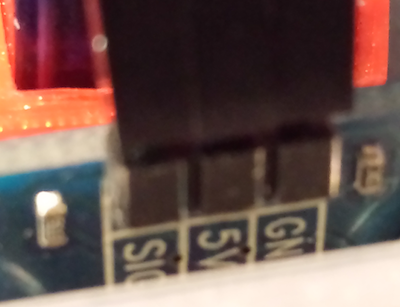
pingpicFor example, this afternoon I was trying to remember the pinout of a sonar sensor that’s already built into a project I’m working on. Try as I might, I couldn’t scrunch my face close enough to read the legend. So I took a picture. It’s blurred and noisy, but it’s good enough to read, even without one of those stick-on macro or microscope lenses.

I’m even wondering whether a video setup might not be better than my magnifying clip-ons. A quick phone-holder on a flexible arm gave me one chip taking up almost the entire screen, and a soldering-iron tip that looked as big as a cold chisel. Then again, fumes and heat and a nice coating of lead vapor on something I hold to my face all day — maybe not.

Posted in possibly useful | Tagged | Leave a comment

Retrobotics

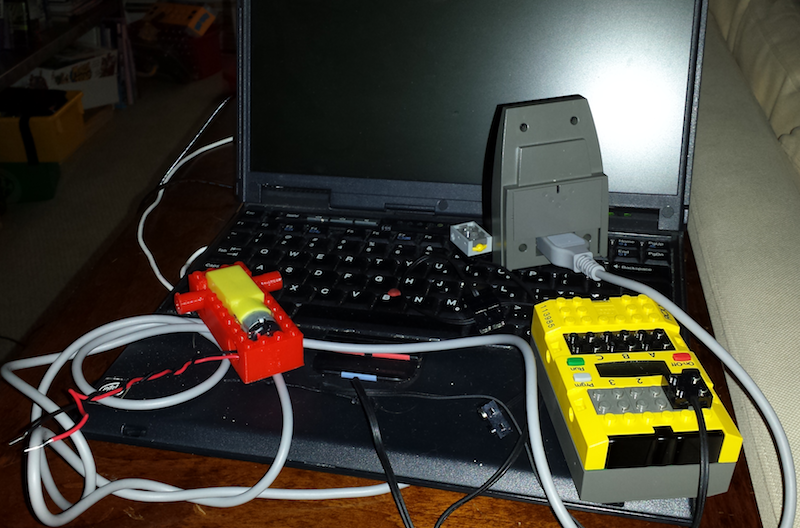
retroboticsThe 10-year-old has been getting into my old Mindstorms RCX stuff. I wrote an article about back when it was cutting-edge, and it’s been sitting mostly idle ever since. The laptop he’s using (the only one in the house that talks reliably to the old IR tower for sending programs to the RCX)  is older than he is, but it still works fine for this kind of thing.

The main RCX brick and sensors work without a hitch, but the motor bricks are seizing up (and I found out the hard way that spray lubricant makes things irretrievably worse). So I printed up a brick-compatible case for one of those ubiquitous gearmotors, and now he can make stuff that moves as well as making noises on command.

He used one of the later-generation Mindstorms kits at a summer camp, but he says he actually likes the RCX better because the hardware and software are simpler. Maybe ultimately less powerful, but easier to figure out what’s going on to start with. I have to admit to liking it better because it’s easier to hack: no worrying about cable pinouts or encoder protocols, just get the wires in contact and go.

But RCX resources are disappearing from the net as ever-newer bricks come out and the hackers who reverse-engineered the RCX ultimately lose interest even in keeping their old code available. Lejos is still out there. NQC, well sort of. pbForth has vanished into the bit bucket. Maybe I should download all this stuff now and put it on a thumb drive to transfer to the old laptop…

Posted in toys | Tagged , , | Leave a comment

Beware the clearance tech, my son

For it will drag you down a rathole.

When I saw that tricolor LED strip marked down to seven bucks at the local Radio Shack this winter, I thought, “what the heck, might as well pick it up.” Less that half the price of a strip from Adafruit, and a less than a quarter of what Rat Shack originally wanted for it, why not?

Because I would have wasted far less time if it had just shorted out in my face the first minute I tried to plug it in.

  1. It requires a separate 12v power supply.
  2. It’s not actually a 30-leds-per meter addressable strip; it’s 10 groups of 3 leds each.
  3. The 1803 controller chips in the strip speak an ancient 400-khz protocol that is apparently available only in RS’s own demo programs (implemented by lots of nops), a few hacks of those programs, and several versions ago of Polulu’s LED library. (FastLED lists the 1803 as possible, but the library wasn’t playing nicely with my installation this week, so I never found out.)
  4. The 1803 and the leds do not combine for an even ramp of perceived light with nominal GBR color (yes, GBR), so you have to diddle the levels endlessly to get the colors you want.

So I thought I would do a sort of quick sketchy prototype-analog  for another project I’m working on that will use an LED strip to represent data over time, but instead I spent a couple days tracking down the bits of code to make my $7 strip work at all, and then another day arguing with the knockoff sonar I was using as a readily available data source. (Oh, and did I mention that the library code for the strip only works with interrupts turned off, so anything else that wants to depend on a timer is mostly out of luck?)

If I’d gone with a regular neopixel strip or some dotstars or pretty much anything but the bargain bin, this all would have been over in a few hours. On the one hand, no one is paying me (yet) for this particular project, so time isn’t exactly money. But on the other hand, time is still time, and there’s only so much of it to go around.

Posted in things that don't work | Tagged , | 2 Comments

Measure Once…

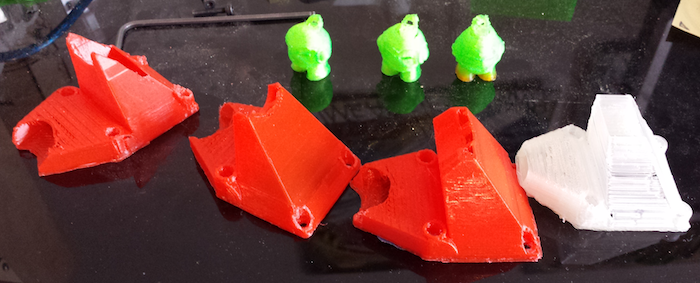
fanprotosThis is what happens when you’re trying to design a part to fit something that you don’t have a good model of. These are all the prototypes of the fan duct I made for my printrbot jrv2, starting on the right with the one where I hadn’t learned how to use Openscad’s offset function, and ending on the left with the one where I forgot that extruding something for a different distance changes the angles of the sides.

fanductThe final version (!) fits pretty well, and clears both the heated bed and the protruding heated-bed adjustment nut about 1cm outboard of the extruder’s default home position. It blows enough air that those little wisps of filament from transport moves trail out on the downwind side of the nozzle, and there seems to be a noticeable increase in print quality for standard PLA. (Albeit I will need to print more than a marvin or three before the verdict is in.) Files at Youmagine for anyone with a jrv2 or a yen to hack bad openscad code for some other machine.

An interesting thing I discovered during the prototyping process: the printhead isn’t quite vertically aligned. Probably because of all of the weight of the stepper motor on one side of the cantilever, there are a few degrees of twist to the head (which means that a duct that’s flat with respect to the head will bottom out on the bed slightly earlier on one side than the other). As long as it’s consistent, I can’t see it making any difference in the final prints, but still  something I hadn’t expected.

Posted in possibly useful | Tagged | Leave a comment

I don’t know whether to be pleased or annoyed

I got a refurbished  HP laptop off a discount site a couple months ago, so that I could have a machine for doing hacker/maker stuff away from home (we have a macbook, but it’s flakey with arduinos and only runs a two-year-old version of Repetier.) It only took two whole days to install Ubuntu on it.

And most of one day was spent downloading and installing all the windows updates that had been issued in the month since I lasted booted the machine up.

It could have been much worse, I guess. I read the instructions and navigated around the installer bug that reportedly wipes out the windows side while not installing properly. I only had to turn off secure boot, rather than turning off the entirely post-2010 boot system. And only a few Windows-side incantations.

But wow. Windows 8.1 really hates people who try to do things the way they used to. And  people with slow fingers. Start menu takes a couple minutes to load (and yes, I shouldn’t need it once I have shortcuts set up, but I need it or a working file browsers to set up those shortcuts). And every time the trackpad-controlled cursor was on top of a button for more than a few seconds, something in the system software helpfully pushed the button for me. Made things take much longer than needed.

So I’ll be installing a bunch of software on the linux side to do basic design work, control my (somewhat) portable 3D printer, program arduinos and so forth. And maybe a few programs (sketchup? heeks?) on the windows side, athough mostly I think I’ll be booting that up to keep up with updates and the slogging job of hunting down an exterminating all the bloatware the machine came with.

Posted in possibly useful, probably boring | Tagged , | Leave a comment

Switching 3D printing filament: purging versus cleaning?

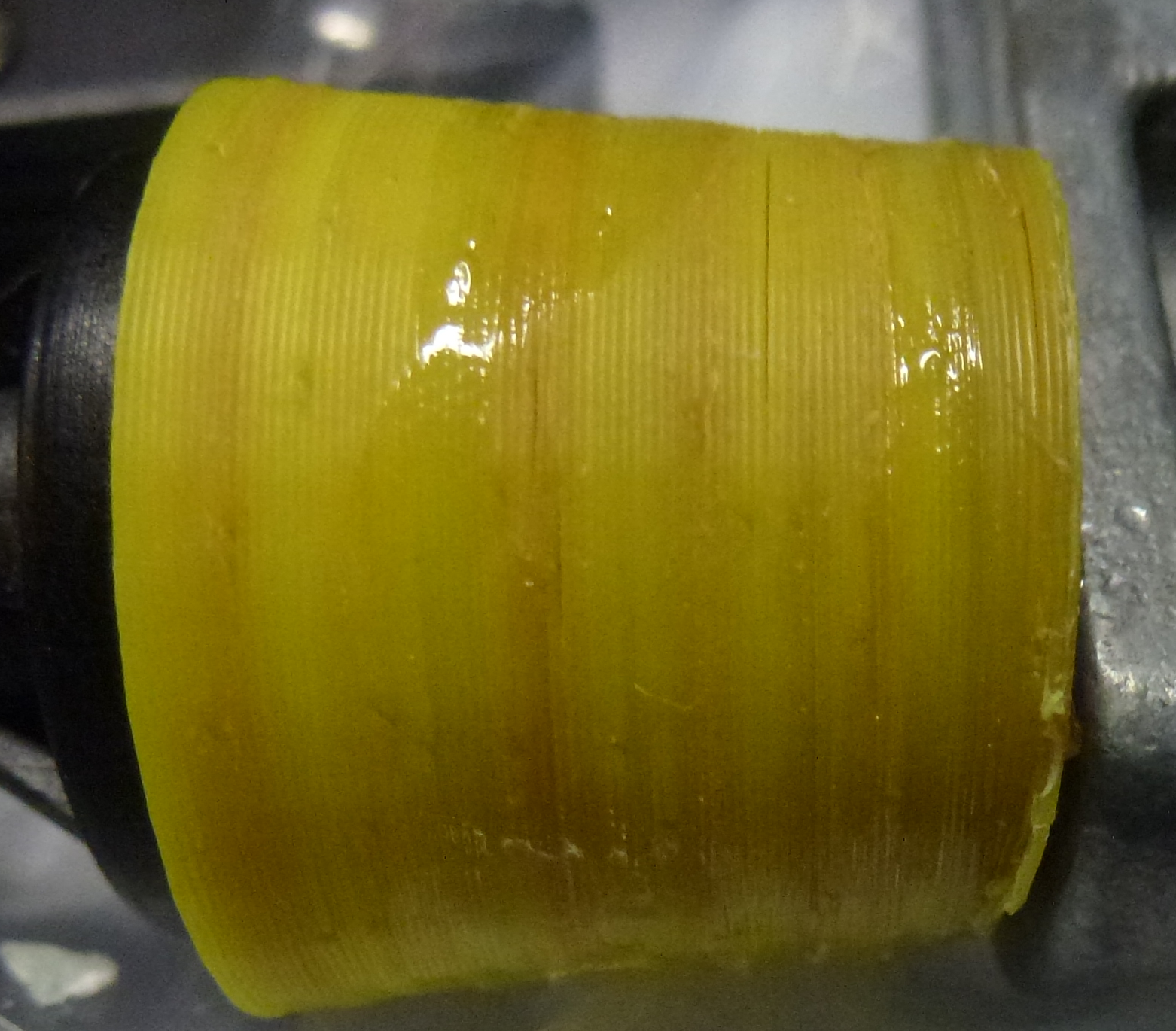
Before building a part out of ABS (because it has to be strong but not brittle) on my Metal Plus, I ran the hot end up to 225C and told octoprint to extrude a bunch of filament. I ran it until the clear PCTPE I’d used for the previous print stopped coming out and the yellow ABS I was using for this one had coming out for a while.cracks

Then I started the part running and monitored it by browser from the other end of the house. Perfectly fine print. But when I got down to the basement, it turned out there were a bunch of layer delaminations, each marked by a line of red filament that I am pretty sure was the PLA that I used on the last job but one. The last of these cracks came after about 6 cm^3 of ABS had been extruded.

So do I just have too much dead space in the hot end? (I promise, I cranked the nozzle on as tightly as I felt safe.) Are these kinds of dribs and drabs usual? I don’t typically switch back and forth that much. Should I just use the other extruder or swap in a different hot end when I’m using a different filament?

drivegearOr do I have a dirty drive gear? I find it hard to believe that bits of PLA would stick in the crevices of the gear and then embed themselves in the ABS and get carried down to the hot end in quantities sufficient to make those red lines, but I don’t know. (I do know that when I was playing with black filaments the other day, it took a cm^3 or two after switching to another color before anything came out that even looked dark grey…)

Any ideas? How much purging do other people do?

Posted in Uncategorized | Leave a comment

Label Your Filament

“Yeah, right, you say, I would never forget to do that.” And then you start getting filament that comes unspooled in a bag, on a cheapo unlabeled cardboard spool, in an unlabeled bag in a box with a label on it (and wore betide if you put it back in the wrong box). And pretty soon you don’t know what’s what.

It used to be there was ABS and PLA. You could tell them apart because PLA and brittle and ABS wasn’t. And ABS extruded at 220 and above, and PLA at 200 and below.Then people started making fancy PLA with tougheners in it. ABS that was kinda brittle. Soft filaments. Filaments with huge temperature ranges. Nylons and half a dozen other polymers. Blended.

So this morning was “extrude all the weird filaments” time in the basement. (Also time to check out the new hot end I got to replace the one on my Printrbot that got turned up to 11 and melted in the great firmware debacle.) Most of them squirted out just fine (Oh, I also printed up one of those flexible filament guides for the printrbot extruder). Polymax is indeed a sweet filament. Trimmer-line nylon: no trouble. Filabot carbon-fiber ABS: great. Ninjaflex semiflex: meh. It extrudes instead of buckling and binding all over the place, but I’ll need a project for it. Taulman PCTPE: delightful. I need to figure out something to build with it, or maybe just a test piece to impress people.

Then there was the not-too-stiff black stuff on a wide no-name dented cardboard spool. Some kind of flexy PLA? I couldn’t find a box or envelope that seemed to match it, but what ever it was, I think I may have made a mistake. It doesn’t extrude below about 205, but above 220 it smokes like the dickens. And the extruded filament is so brittle it just crushes in your fingers.

There’s a chance it’s absorbed too much water — the nylon smoked some too — I’ve been so used to winter in Vermont, where the relative humidity in the basement is down around 10%, but now it’s early summer, where 90% is more like it. Time to put together that dry box and leave it out in the sun for a while…

Posted in possibly useful | Tagged , | Leave a comment

Octocopters are the new normal

So at this afternoon’s maker meeting at the library, while the kids were soldering LEDs and making very loud reeds out of plastic binder clips, Tim showed off his multicopter, which he uses for HD video and photography.

It stands two feet high and covers up about half of one of those long folding tables, with the controls and the remote camera rig taking up the other half. Eight counter-rotating rotors, top and bottom the same size in contradiction of the recent analyses that  say you get more efficiency with a smaller bottom rotor (and also in contradiction of the older analyses that said you got more efficiency with a smaller top rotor).  16 channels of telemetry plus a camera feed.

And apparently completely outdated and inadequate. Tim’s next one is going to be about half again the size, with 15″ rotors, a bigger main plate for better battery mounting, rotor arms that bend upward in the middle to get out of the way of the camera, retractable landing gear ditto, and a three-axis gimbal system instead of this one’s mere two axes. And better vibration isolation, better-balanced motors and props, a new flight control system once the bugs get shaken out…

And it might not even cost significantly more. Apparently prices are falling fast enough that for the money that bought you last year’s streaming HD video system you can buy a whole copter with that same streaming transmitter built in. People are building cameras specifically for aerial use instead of hacking on handheld versions, and so forth. No wonder Tim is training his 12-year-old as a camera operator.

This is what the rising part of the classical S-curve looks like.

Posted in going places, making | Tagged | Leave a comment

Montpelier Maker meetings

A bunch of us got together in the library basement as usual. The kids made a bunch of eggbot eggs and a blinking arduino; the grownups talked about projects ranging from fan-based lissajous figures and photonic communication demos to mobile robots based on treadmill motors. And made plans about getting more visibility (fair, contest, workshops, any other suggestions?) and whose local space to start setting up machinery in.

Next meeting Thursday April 23, 430-7. Then in may we’ll be switching to Wednesdays to avoid a conflict with the high school’s Ultimate Frisbee team, so May 6 and May 20.

Posted in going places, making, possibly useful | Tagged | 2 Comments