Surface Mount LEDs on Paper

5050test
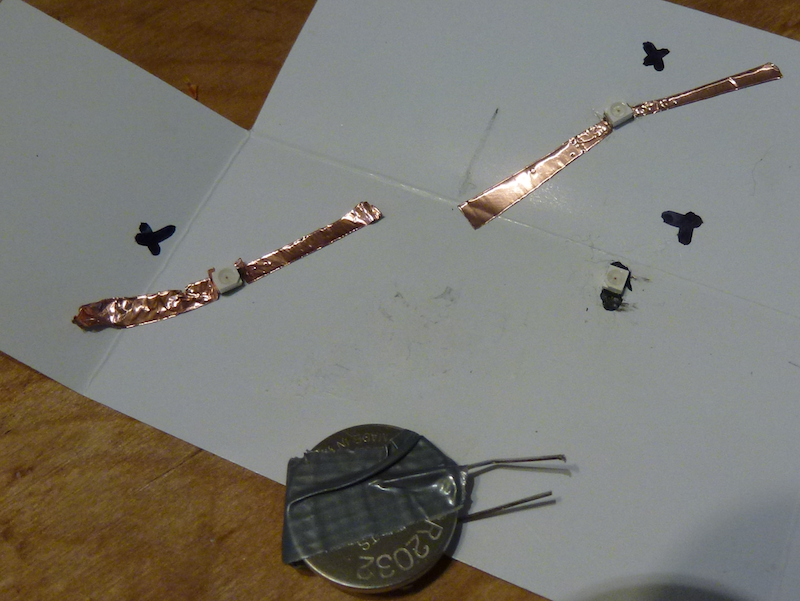
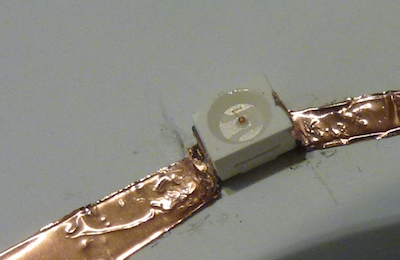
Even without a magnifier, my old eyes and fingers can deal with some of the bigger SMT LED packages.  I’ve been doing some tests to figure out the best way to mount and connect these.  A couple dabs of wire glue applied with a syringe definitely do the trick (although the stuff takes an hour plus to dry) but getting anything else to make good contact with the glue trace is, uh, difficult. And resistance, as we know, is high.

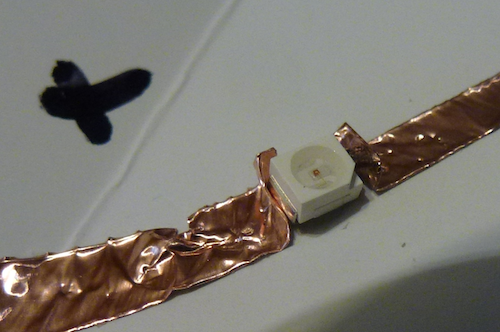
I tried two different methods with copper tape: one with the tape adhering to the contacts and burnished in as hard as I could manage, the other with a dot of glue holding the LED in place and then a folded-over end of tape mashed against each contact to get a metal-to metal connection.
5050burnish

burnished

5050folded

folded

Both methods work. I was surprised at how well the tape holds — you could probably even use it to suspend an LED in midair if you were so inclined. The glue-dot method makes the LED much easier to handle, though, and the resistance is a bit lower when the copper is actually touching the led. So maybe a fast-drying glue, then some burnishing once everything is in place? I’m not sure, but I do know I like this better trying to coerce through-hole LEDs and their wires to lie flat and behave.

UPDATE: This afternoon the circuitscribe pens I backed on Kickstarter way back when finally arrived. So I drew a few lines. Yes, you can extend copper-tape line with the silver ink. No, it doesn’t really connect reliably to the wire glue (burnished copper tape does better). Yes, drawing some wires on paper and plopping an LED on top works, as long as the led doesn’t slide away (still need some kind of infinitesimally thin dot of glue). At roughly $20 a pen and a rated 60-80 meters of line per, the cost is lower than Adafruit’s copper tape, but not if you take your scissors and slice the tape in half lengthwise. But still: wow.
Posted in Uncategorized | 1 Comment

Goodbye Green ABS

ABSchangeThere it goes, the last scrap of the first kilo of filament I ever got. Halfway though a print, of course, so I just pushed some lousy glow-in-the-dark stuff — the only other 3mm ABS I had handy — through right behind it, and the extruder didn’t even hiccup.

I’ve been trying to work down my inventory of 3mm filament (including 5 pounds of PLA ordered in more optimistic times) but this isn’t really a good time to be running out of ABS entirely, so I might just head down the road to Filabot and pick up some stopgap. I wonder what color…

Posted in making, probably boring | Tagged , | Leave a comment

More Shapeoko parts

I’ve been working on a revised set of shapeoko-2 endstop parts, and now they’re up at Youmagine, along with a few pictures. I decided on mechanical endstops for all three axes, both because that’s electrically simpler and because microswitches are way more repeatable than you would think. The ones in my 3D printers appear to be good to at least a tenth of a millimeter, which would be a couple widths of a human hair, and almost certainly way less than the flex in the rest of those machines.

I was thinking about something different for the Z axis but finally decided that would be stupid. The gold standard is an electrical-contact sensor between the bit and a perfectly measured plate set into (or onto) the bed of the machine, but that means something that will maintain electrical continuity with the bit and chuck while not in any way interfering with their rotation at 30,000 RPM.And I’m too lazy to debug that. An optical sensor would be fine, but I can’t figure out something that will be equally sensitive at registering a 3mm end mill and a 0.05mm engraving point.

s2z

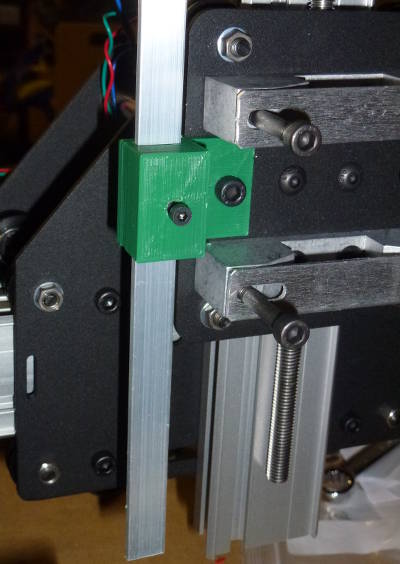
So I settled for a separate, adjustable probe and a microswitch. If that ever turns out to be the limiting factor for the machine’s accuracy (stop laughing whenever you want) I’ll fix it. Except the S2 has a new spindle mount. I can’t use the trick from the S1 of letting the probe lock into the aluminum extrusion that holds the spindle, because there isn’t one. So I printed up a cute little piece that bolts to the spindle mount and holds a piece of leftover aluminum 1/8 x 1/2″ bar stock. The M3 bolt that locks the bar in place is also left over, from my original Cupcake CNC build. Thanks, Reprap Research Foundation….

Posted in making, possibly useful, probably boring | Tagged , | Leave a comment

My hallowe’en costume

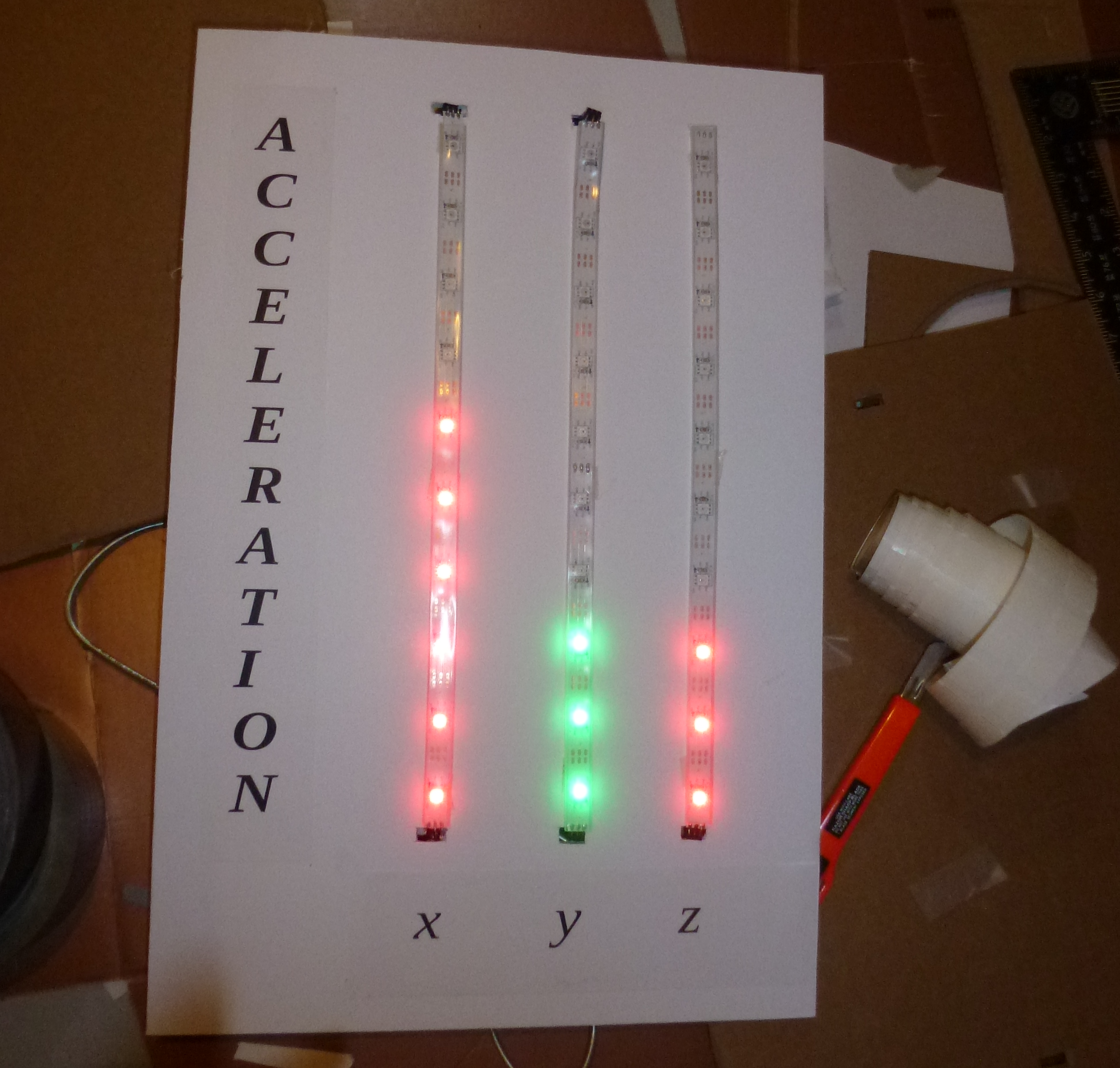
accel1Yes, I’m going as a bar graph. I’m an ex-physicist, a tech writer and a geek, so it’s perfect.

I have to admit that after 30 years of working on technical illustrations that ended up on magazine covers and people’s walls as art it’s a little bit of a come-down, but hey, this one is interactive.

So that’s an Adafruit neopixel strip, sliced up into three sections, with little right-angle headers and jumpers wires connecting them behind the scenes. Also on the back of the foamcore: a 14-bit 3-axis accelerometer, a power distribution strip and an arduino clone sold by some folks down the road. (I like their boards particularly, because they put a bunch of 3-pin headers in the spare space, with Vcc, ground and signal all right next to each other. )

The code for all this is very simple, mostly lifted from various example files. I get the accelerations, divide them by a moving average of the past couple seconds, and then scale with a square root so that 10 LEDs can represent a reasonable dynamic range. Green is acceleration in the positive direction, red is negative. The library for reading the accelerometer is huge, so the whole thing clocks in at almost 10K — if I wanted to do this with a Tiny84, I’d have to roll my own.

Also , I’m stupidly proud of the display routines — the LED segments are connected in a sort of capital-N shape, so getting lights to go up and down on the y-axis segment requires logic that’s backwards from the other two segments. Simpler to connect, marginally harder to code.

Oh, and it’s all powered from a backup battery with a couple of USB plugs on it. Batteries with USB out have become so standard that it doesn’t make much sense to use anything else, even it it’s not really ideal as a power connector.

Posted in making, toys | Tagged , , | Leave a comment

Hallowe’en in a box

Just add switches and a 9-year-old geek.

Halloweenbox05

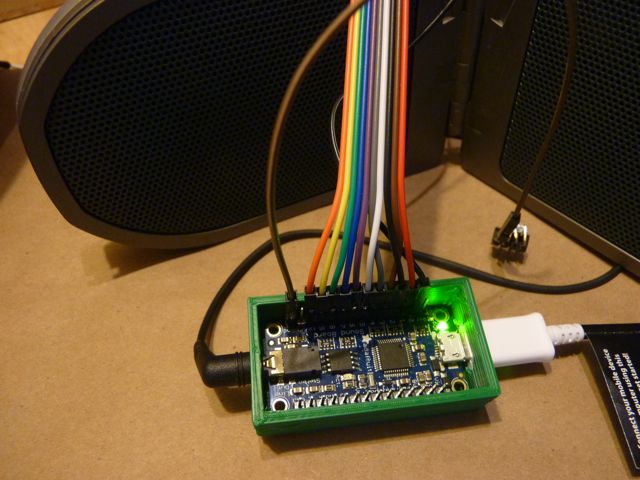
That’s Adafruit’s FX card, which can store 2MB of sound files and spit them out to a powered speaker based on any of 11 trigger lines. With additional modes including looping, sequential (play the next soundfile in a series each time the trigger line goes to ground) and  random (pick one of a bunch of files).

It’s cool, but more especially it’s simple. You just plug it into your computer and transfer the files — there’s a naming convention for the files that says which trigger pin to use and which mode. If your microcontroller has enough smarts to emulate a flash drive and play .wav and .ogg files, it certainly has enough smarts to do the right thing based on the sequence of characters in a file name. Bonus: there’s a cheat sheet on the back of the circuit board (and yes, the back of the box I fabbed is open so I can read it).

The only thing I have to complain about is that there are 11 trigger pins to bring to ground but only 4 ground pins, which means you need to build a common ground bus for some of your switches. Fine in a permanent installation, slightly less perfect if, say, you’re wiring up a haunted room with sensors all over the place. I just took a piece of header and soldered all the pins together. The circuit board is also pretty dense — if I were using mounting screws instead of a box, I’d have to mount it component-side down so that the screw heads didn’t crush a bunch of adjacent stuff. Which I guess is the right thing to do anyway, because cheat sheet.

Can’t wait to figure out what to do with this once it’s not Hallowe’en any more.

Posted in making, possibly useful | Tagged , , | Leave a comment

Inside a scanning electron microscope

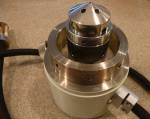
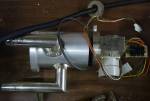
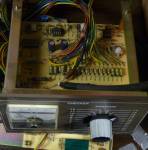
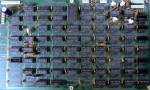
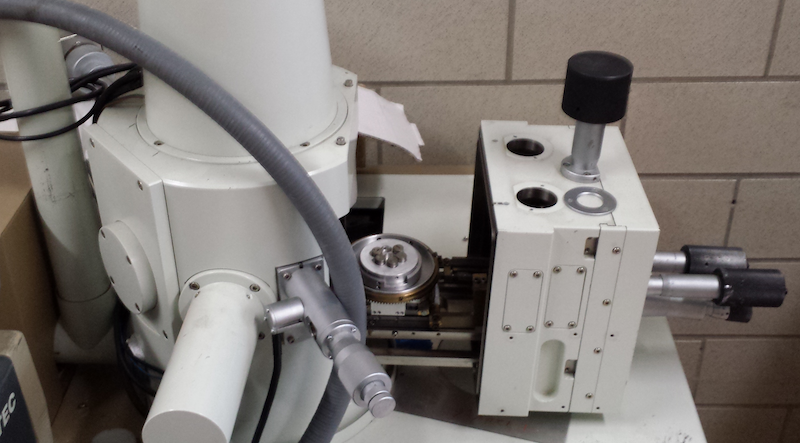
Some of the parts I was able to salvage. I’m a sucker for big chunks of stainless steel. Also, I am thinking maybe I could turn the sample stage into the world’s smallest-working-envelope 5-axis CNC machine.  It couldn’t deal with anything much bigger than an inch on a side, but the resolution would be down around 2 micrometers…

Posted in things that don't work | Tagged , | 1 Comment

Beautiful scrap

Scanning electron microscopes are really heavy.  I know this because our local high school just sent theirs to the scrapyard,  and I got to spend the morning scavenging all the bits I could take off  with a screwdriver, and a set of allen wrenches. The electron gun, for example, is about the size of a softball and very nearly solid metal.

“Wait,” you say, “Your local high school had an SEM and they scrapped it?!?” Well, sorta. Some researchers at the big IBM facility an hour down the road had an SEM back in the early 90s, and when they’d used it for about 10 years and needed a better one, instead of scrapping it they put it in a truck and brought it to the high school, where they explained to the facilities people about chilled-water supplies and 100-volt electrical feeds and the care and feeding of diffusion pumps. And some of the researchers even helped advise on how to to fix it when it broke. And broke again… (And when the school board is arguing over the cost of a third of a music teacher, “We need to upgrade our SEM” is not that high on the list of budget priorities.)

So when the school needed space for a computer lab, the SEM was up for grabs. The high school physics teacher (who is also a makerspace person) called me in, because the vacuum system was pretty similar to the ones I worked with in college. All it needed, according to the experts, was a new diffusion pump and a new high-voltage power supply and maybe some new electronics. But most of all it needed to get out of the hallway where it was in the way of the fire exit.

Which is where we get back to heavy. Not amateurs with a pickup truck heavy. Professionals with lifting tackle and reinforced suspensions heavy. Too heavy to just drive to someone’s garage and let it sit there while we figured out whether fixing it was worthwhile. Too heavy to devote all your spare project time to for the indefinite future. (A quick look at ebay suggests that you could probably find the parts for under a grand, plus the cost of custom machining and the labor of some poor sap cleaning out the inside of the entire compromised vacuum system with acetone and nitric acid. And the time to diagnose and repair the old logic boards and splice all the wires that got cut to move the thing into the hallway. For that you could build a whole new atomic force microscope.)

Well, at least it had another good decade.

You learn a lot from taking things apart. Old-school circuit boards with lots of socketed components and plugs and wires connecting the boards. The main vacuum chamber that must have been machined out of a solid piece of metal the size of a scuba tank. All the ports for optional widgets, each sealed with a perfectly-machined blank. Held together with more socket-head screws than I could count, ranging from the little 3mm jobs that are the small change of maker builds everywhere to monsters that would have been at home on a carnival ride or and oil rig. Micrometer screws all over the place.

stage

I got much further than I’d thought — at first, all I really wanted was the sliding — and twisting, turning, and raising and lowering — specimen stage (see above). But things just kept coming off. I must have lightened the scrap load by three or four hundred pounds. For only one item did I need a hand: a burly experimental physics student helped me wrestle the rotary vacuum pump off its hanging-spring suspension, out the exit door and into the back of my little car.

Now, of course, I have no idea of what to do with most of it. Anyone need a just-barely-portable rotary vac pump for a project? Or a bunch of probably-functional LSI chips?

Posted in possibly useful | Tagged , | Leave a comment

UV-curing resin as an extrusion material

I’ve been working on a DLP printer project, and I’ve gotten to the point where it might be a good idea to know what kinds of layer exposure times I might expect. So I loaded up a syringe with Makerjuice that was lying around from gosh knows when, squirted a couple drops on a piece of glass, and ran it in front of my projector. The last time I bothered to read up on this, people were talking 30 seconds and up per layer. This was fast. Which is good.

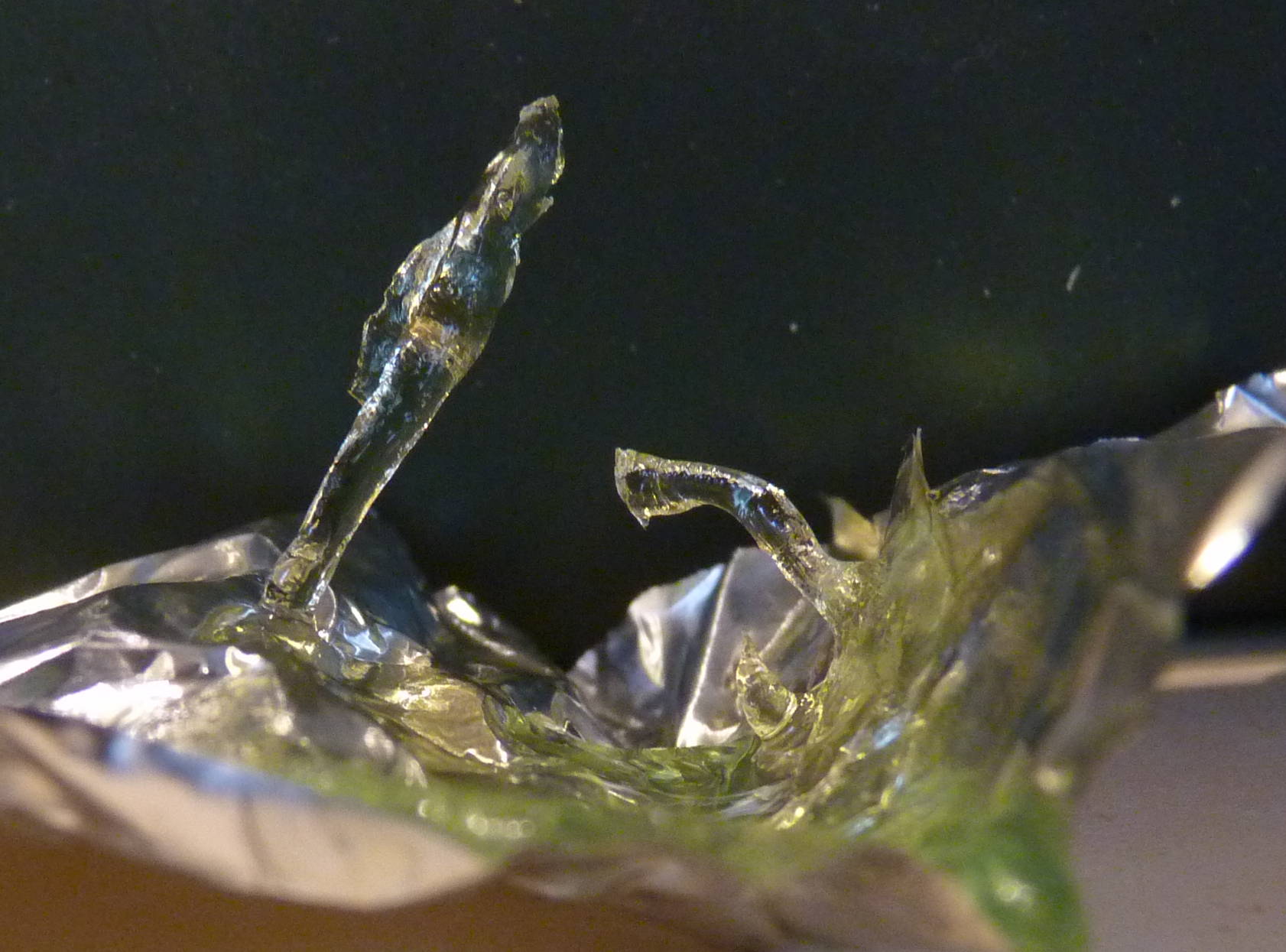
So there I was with the rest of a syringe full of Makerjuice. And a UV flashlight on the shelf somewhere. I decided to see what would happen. As you can tell from the picture, when the tip of the syringe was in the center of the beam the resin cured as fast as I could squirt it out. In fact, I got a sort of lava-tube effect, where the cured resin shielded the stuff coming out of the syringe until it reached the end of the tube and got exposed to light, making more tube and so forth.

I know that actually trying to print with this stuff would be well-nigh impossible — the shrinkage, the smoke, the smell — but it’s interesting to think about how you might do it. You’d need a very fine syringe, and shielding so that the UV never actually touched the extrusion tip, and UV-proof visible parts for the whole machine. Or maybe just a resin with different viscosity and curing properties… Eh. The whole point of DLP is making something that can speed you up by printing a whole layer at once, so it’s probably not so bright to figure out ways of making the process really slow.

UVcolumns

Posted in things that don't work | Tagged , , | Leave a comment

It never rains but it pours

So now there seem to be three separate makerspace initiatives in town, all serving more or less disparate potential communities — youth/educational/entry-level, light hacker/maker, heavy-equipment expert maker. In some ways those are useful divisions, because you don’t necessarily want to teach arduino classes in the middle of a machine shop. But I wonder how big an audience those segments have beyond the half dozen of us who are talking amongst ourselves.

(Then again, when I did a lego robotics camp this summer, to a parent the adults who came through the room were begging for resources to help them keep up with their kids, so maybe that segment is larger than I think.)

(Oops, just got more email, make that four. I wonder who else will come out of the woodwork.)

Posted in making, possibly useful | Tagged , | 2 Comments

Getting Inspired

It was raining pretty steadily, but it was definitely fun. One of the things I liked was the not-so-high-tech makers: the folks who do amazing things with printed pages, the blacksmith, the people who are starting up a sailboat-based freight operation across Lake Champlain and down the Hudson river…

The character of some of the higher-tech exhibitors has changed. For example, Jon Bondy of Vermont Rapid Prototyping wasn’t just doing “Here’s a 3D printer, isn’t it cool,” he was showing how 3D printing and cheap smart electronics could turn ideas and sketches into working stuff.

And although it was 50 miles away, I still ended up seeing a couple people from from Montpelier: Tyler McNaney from Filabot was there (as an onlooker, not an exhibitor this time) and brought me up to date on their big-printer project (they’re not going to use the gantry crane after all, just a bunch of 80:20 extrusion). Mara Siegel of the Vermont Department of Libraries was running a booth and talking about library makerspace projects (and boxes with 10,000 Lego pieces in them). Didn’t see any of my kids’ friends or their parents; I’m betting they had the good sense to go today when it’s gloriously sunny.

Other people apparently enjoyed the Faire too — one of the local people who has been on-again, off-again about pushing for a local makerspace emailed me late last night, and is emailing some powers-that-be with what might actually turn into a plan.

Posted in going places | Tagged | Leave a comment