Fat Marvin

While I was fiddling with the acceleration settings on my Printrbot JrV2 to get less shaking and perhaps more accuracy, I discovered that reducing the acceleration below 1000 mm/sec^2 pretty reliably caused the machine to stop working  partway through a print. (I can imagine Marlin getting into a situation where it can’t look ahead enough moves to get the acceleration numbers down and quitting in disgust, but that’s probably not the reason.)

So I figured “Two years since the last firmware update, maybe it might be time,” and borrowed my spouse’s MacBook, because there’s a really cool app for OS X that gets the right file for your particular printrbot, handles the twiddly DFU syntax and generally reduces cognitive load.fatmarvin2

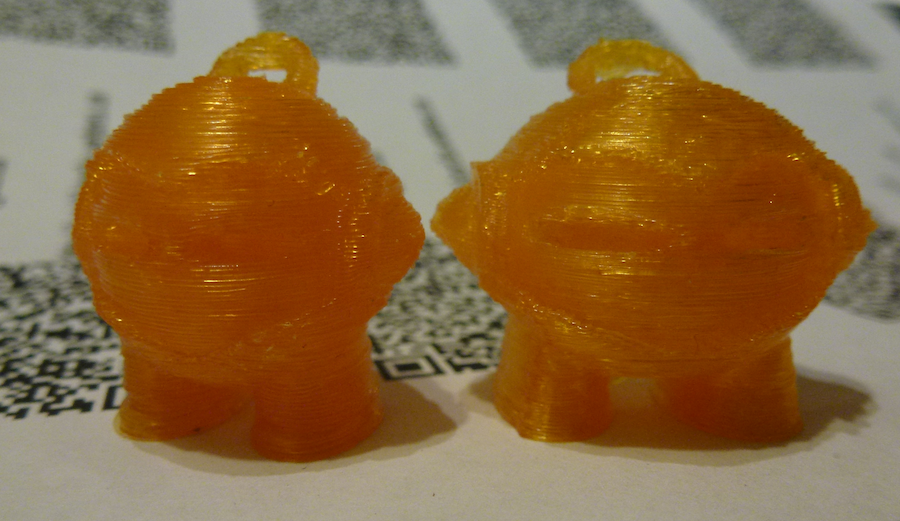
And then this happened: Everything displayed fine on Repetier’s layers-in-progress visualization, but the result was, er, not exactly the alien my 7-year-old has come to know and use in games.

So I whipped up a 20x20x10mm calibration cube in openscad and printed it. Hmm, just shy of 25mm on a side.  The M501 command to list settings tells me that X and Y steps per millimeter are the 80 standard for a JrV2, but apparently my JrV2 isn’t quite standard (and since it was kindly calibrated at the factory after assembly, who needed to know?).

A few micrometer checks of Y travel later, it looks like steps/mm is about 62.99, which looks suspiciously close to the number listed on Printrbot’s site for the JrV1. Did someone have a few old pulleys in the bin? Do I really care, as long as I can get the right number dialed in?

But I have to say, once I do get the right number I’m probably going to go back to the scale control in Repetier and make some more fat Marvins. They’re kinda cute.

Posted in probably boring | Tagged | Leave a comment

True North

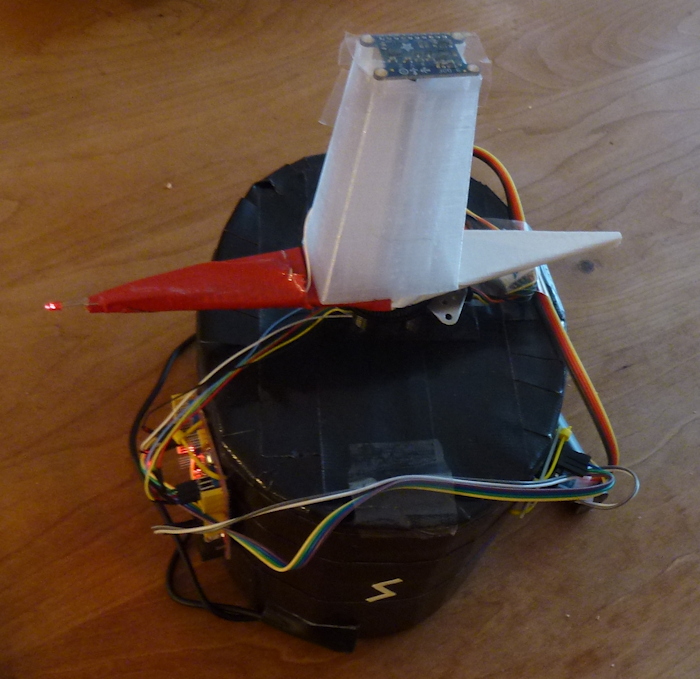
rotatedWell, except for declination error and any nearby metal objects, and within the resolution of the stepper motor…

Ingredients:

The design is pretty much a matter of one questionable decision leading to another. At first, I wanted the sensor firmly mounted on the hat, but then I would have needed a foolproof way of measuring the angle of the needle (because skipped steps and unknown position at power-up). That was too hard, so the sensor had to move. And that in turn meant a slip ring, because the compass needle can rotate an arbitrary number of turns. And a slip ring meant the gear-shaft stepper, because the much-more-accurate BYJ-48 couldn’t drive anything on the far side of a slip ring without being geared itself, and why print and mesh two gears instead of one? Oh, and I could have used a motor-driver chip and driven the stepper with only 4 wires, but this is Halloween, so another set of blinking lights is all to the good.

This turned out to be a pretty good Halloween piece, because it’s subtle. Nothing happens until I turn my head. (In fact, when I first went out to supervise the kids trick-or-treating, someone stopped me to say “Hey, something’s wrong with your hat, it’s not spinning!”) It generally takes people a moment to figure out what’s going on, and then they like it.

The whole thing took longer to make work than I thought, mostly because I was confused about my directions: when the compass heading is positive, I have to tell the stepper to move clockwise to bring it back to north, and vice versa when it’s negative. So for a day it tried its best to point south while overcorrecting terribly in the wrong direction. Also, averaging angles (which you have to do because the measurements are noisy) is hard unless the angles are all in one quadrant, so finally I gave up and just put in a calibration spin at startup. And if I had it to do over again, I would definitely make a better hat. This one had no internal support and really wanted to slice through my ears by the end of the night.

Posted in making, toys | Tagged , , , | Leave a comment

Sometimes the old ways are best

So after HP finally replaced the lemon laptop that I’d gotten this spring with a brand spanking new touchscreen laptop, I waited until I had a few completely open days to do a dual-boot install of ubuntu on it, just in case there might be a few problems.

Four dozen open tabs later…

Apparently when a machine boots from USB but can’t see the internal hard drive, it’s either

  • a power-supply problem
  • a busted SATA cable
  • a protocol disagreement in the BIOS
  • a bug in the BIOS
  • an error in the table that supplies the kernel with addresses for registers in the IOMMU
  • the phase of the moon.

Of the non-hardware problems, for each one there’s a different set of GRUB boot parameters that some people have found leads to a successful boot and installation. (And the hardware problems seemed unlikely — even for HP — because the machine was running Windows 10 like a champ. And I even started to like Windows 10.)  Some of the fixes require dumping a bunch of register tables and then poring through datasheets, so that was out for me (especially because once — just once — after I updated the BIOS the internal hard disk actually appeared for an hour or so).

So I asked around at our co-working space, and another guy had a desperate need for a cheap Win10 laptop.  I cannot tell you what a weight lifted from my shoulders as I saw the last of the computer.

And I went down the road to the used-computer store. There was a business-class laptop from 2012 loaded with Windows 7. Coincidentally for the same price my colleague had paid for the replacement of the spawn of hell. I plugged my USB drive with the ubuntu installer on it into the side of the older machine and turned it on. Hit ESC to choose the boot device. It just did.

And then when I got it home, the installation. just. worked. in the partition that I’d carved out by telling windows to shrink the C: drive. Now I’m loading software on it and it still just works. I could have done this six months ago and gotten ever so much more work done. And just in case you wanted a kicker: the new/old machine benchmarks about 10 percent faster than the new/new one I ditched.

Posted in probably boring | Tagged , , | Leave a comment

The Roombaphone

It might not be the most over-engineered way to make low-quality 8-bit sounds ever, but I think it’s in the running. This is what comes of allowing a 10-year-old access to the basement.

My mother-in-law got a Roomba for christmas about 10 years ago and never had a use for it, so it’s been waiting about half that time for me to turn it into a base for a mobile robot. It’s the kind that has a serial port on the side especially for hackers, because that was the way iRobot worked back then. Also in the basement: a bluetooth-to-Roomba dongle from Sparkfun, acquired back when they were clearing out the last of their stock.

There’s a mac app (explains the 10-year-old) for controlling the Roomba. It can make the oversized puck turn on and off, go forward, turn, activate its cleaning tools — and play the notes that the Roomba uses to tell its owner that it’s stuck somewhere. The app even has a little onscreen keyboard that you can use to play tunes.

But wait. That’s not obfuscated enough. Instead he had to plug in a two-octave usb/midi keyboard and select the Roomba as his instrument. So to review: Korg Micro plugged into a macbook’s USB port. Macbook bluetooth link to Roomba bluetooth dongle. Roomba bluetooth dongle to Roomba serial port to tinny little Roomba speaker.

Ain’t technology grand.

Posted in toys | Tagged , , , | Leave a comment

I’m a little puzzled by these loops

benchpetplus(PET+, 250 degrees, .25mm layer height, 60 mm/sec, no additional acceleration control)

I think I know what most of the other issues are — the blebs are from not retracting enough on layer change, the ringing is from running too fast, the general unsharpness is from extruding too much and probably too hot without enough fan. This is the profile I use for banging out utility prints, and I wanted to see how it would do before tightening things up.

But those loops in the front window don’t make sense to me. The bridging on the roof did just fine with no sagging, and the inner and outer perimeters are fine too, it’s just one strand from each layer that sagged down. I guess maybe the middle strand wasn’t touching its neighbors and was still hot when the next layer went on top of it, but that doesn’t really explain why something similar didn’t happen with the roof. Any thoughts?

Posted in things that don't work | Tagged | Leave a comment

Ubis 13: Just a better hot-end?

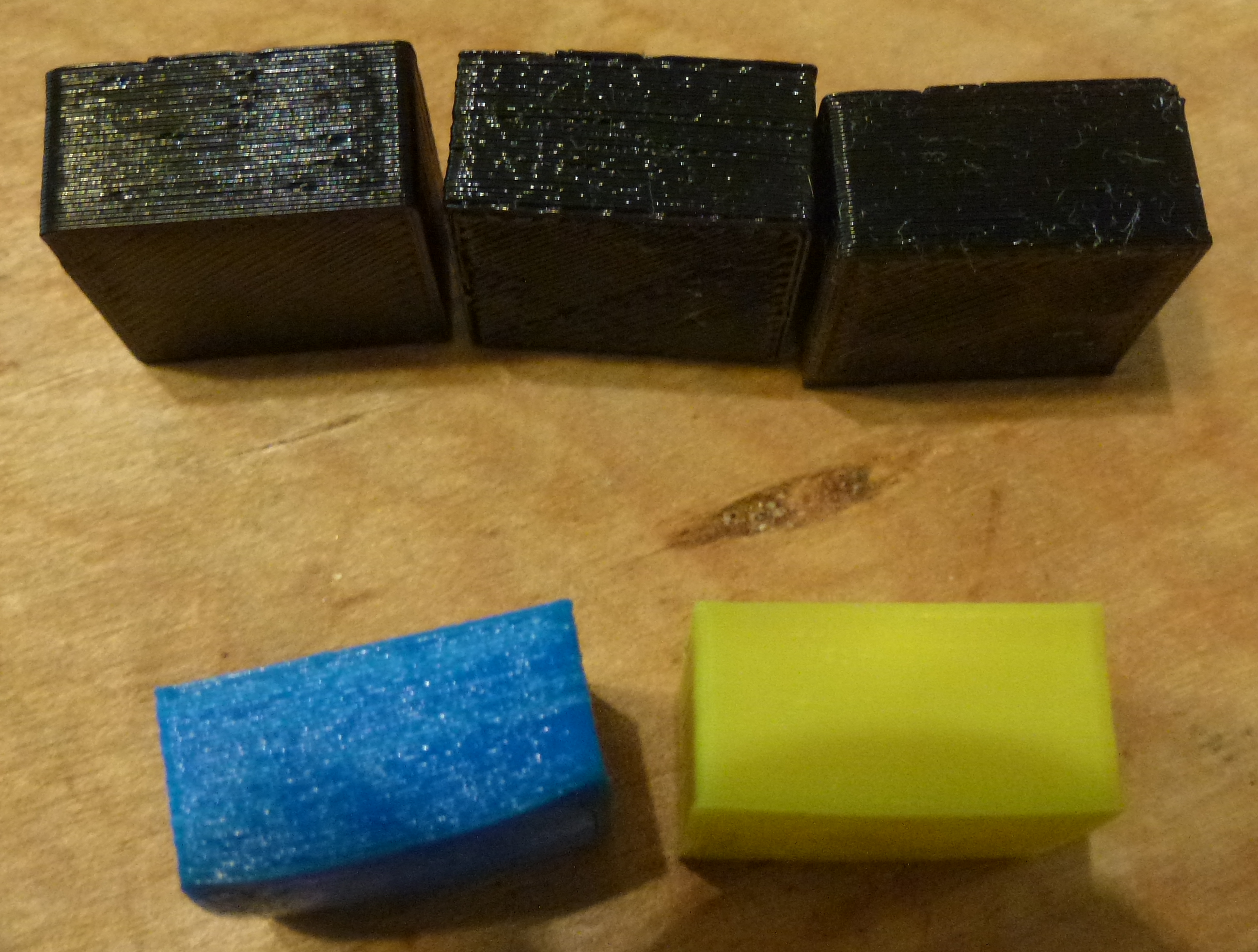
So the all-metal hot-ends finally arrived, and I fixed the Metal Plus so I could actually use them, and I’m a convert. First, of course they make it possible for me to print with filaments I couldn’t use before, like MadeSolid’s PET+ (which could become my new favorite filament as soon as I get it in more colors) or the bulk blue lawn-trimmer strand all the super-frugal folks were raving about last year.

But I’m also finding that the all-metal hot-ends are doing a better job on filaments that gave me trouble with the standard Ubis hot-ends. Some local ABS that used to clog my nozzle within half a meter or so did fine for a three-hour print. The off-brand black PLA I had marked “do not use” prints up just fine. Polyflex, which I was gingerly extruding at 10 mm/sec, now runs at 30 (even if I still have to rotate the spool by hand).

cubesOh, and do you think maybe I should start getting more filament in colors that aren’t suitable for a Model T?

Posted in possibly useful | Tagged | Leave a comment

Clearing the deck

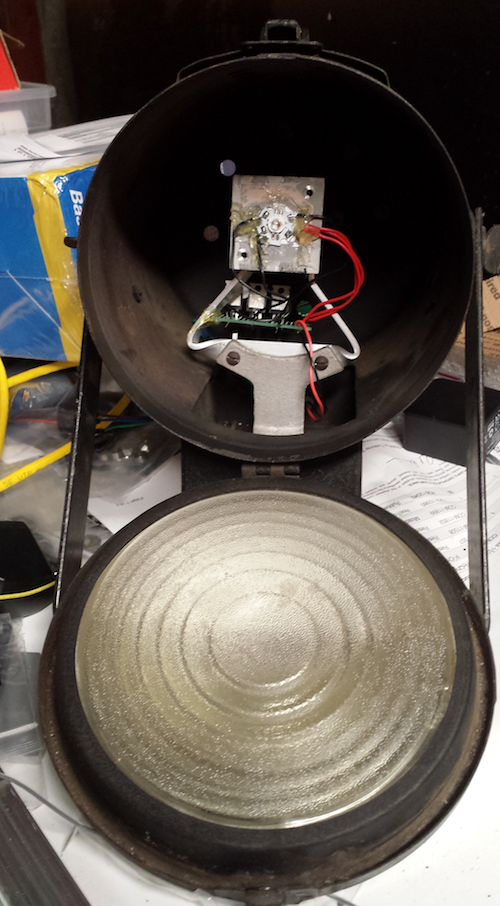
Back in my misspent youth, I was a stage lighting geek. Lots of time on ladders with a speed wrench, hours poring over swatches of filters with names like “Surprise Pink” and “1/4 CT Blue”. So years later, when I saw an old 6″ Fresnel in a junk shop I had to have it. And it hung there in the basement ever after, reproaching me for not doing something with it.

gutsUntil I saw a high-power RGB LED at Adafruit. After a few false starts (should have read the detailed triple-LED-driver specs and discovered before I bought it that it doesn’t do common anode) I rolled my own way-too-simple driver  from three MOSFETs  and some 5-ohm resistors and mounted the whole thing where the fresnel’s mirror used to go (LEDs already point all their light forward).

For control, I’ve got an arduino clone that claims to supply two amps of spare power and a little proto-board with three potentiometers. So it’s just like an old-fashioned stage light: set the color and forget.

fresnel-lightDoes it cast enough photons to be useful? Maybe. I haven’t cranked it up to full power yet; I’m a bit scared. But at least it’s one less project cluttering up the workshop and my brain.

Posted in toys | Tagged , , | Leave a comment

Champlain Mini Maker Faire

We all went this afternoon and had fun. I think that the Faire is in an interesting transition: there were fewer geeks trying to sell toys to other geeks and more activities for ordinary people. 3D printing was just assumed as a tool, rather than being a thing in itself. Lots of fabric-related stuff, including a bank of sewing machines for kids and grownups to use for hacking tee shirts mand so forth (The 7-year-old made a fuzzy pillow for his stuffed monkey).

There was the soldering tutorial row, of course, but then the folks at Create Make Learn also just had an iron lying out on a table ready for young and old to build things with. (The 10-year-old soldered together a little thingy to fade between two LEDs, but the potentiometer went wonky on him…)

And Miss Vermont having fun with her peroxide and potassium iodide demo, with the warning “Don’t do this at home. Do it at your friend’s home.”

It will be interesting to see how things have changed again next year.

Posted in going places | Tagged , | Leave a comment

You get what you pay for, yet again

Dunning and Krueger strike again. I thought I knew the retail PC industry well enough, just because I’ve chatted with so many of the people who invented it. But times have changed.

This spring I bought a refurb windows laptop because I needed a machine to take to maker events (like the library meetings) and run a 3D printer or an arduino or whatever. And the most recent version of Repetier that runs on a macbook is from 2013.

I had great dreams for that laptop: I was going to make it dual-boot Ubuntu, I was going to get a copy of Labview from Sparkfun…  But no. I unpacked it. I let it download windows updates. I downloaded Firefox and cleaned off the desktop links to the most obvious bloatware. Then it rebooted and told me it had detected an imminent hard disk failure and to get my precious data off ASAP. I didn’t have any data on it yet, so I just booted it again, only to be informed that there was no hard disk present.

Luckily, the machine was still under the (short) refurb warranty, so I called, explained the problem (“my machine insists it has no disk”) and got a response: the company sent me a shipping box by 2-day air service so that I could return it.

A week or so later I got my laptop back, with a new hard disk and a promise that it had been extensively tested. Nuh-uh. It stayed up for an even shorter time. Not only an insistence there was no disk, but ostensibly not even the firmware to check whether there was a disk. Rinse and repeat (I was beginning to admire my collection of laptop shipping boxes).

The third time, I called in the morning and reached a tech who recommended I take out the battery and let the laptop sit for a while to dissipate bad karma or something. When I put the battery back in, lo and behold the machine booted successfully and remained working for several hours before announcing yet again that it was toast. So I called and got to another tech who gave me what he claimed was the number for people who could authorize a replacement. But that number went to a cheery voice menu system that said “If you have a problem, go away and try and find an answer on our web site.” So I called back, got another shipping box and enclosed a note saying “Don’t just replace the disk and send it back. You tried that already.”

Replacing the motherboard and the touch pad and performing more “extensive testing” apparently didn’t do the trick either. Sometimes no disk present, sometimes imminent disk failure, once windows decided that it had been pirated and copied to another pc and refused to boot. All the messages boiled down to “You Lose”.

So I called yet again and got a tech who seemed genuinely miffed that I wasn’t willing to spend a couple hours running through the troubleshooting tree with him, and finally agreed to “escalate” my case to the people who could authorized a replacement. I learned the trick to the voice menu system — in my naivete the first few times I called, I hadn’t thought to ignore everything the chirpy greetings said and just press “0” repeatedly until a human arrived. (Oh, and may I say that Up-tempo distorted Pachelbel’s Canon played at full volume seems designed to drive people on hold to hang up in fear for their eardrums, a little like those uncomfortable fast-food chairs, or the city benches with spikes on them? )

A few more tests of will and a round of phone/email tag, and the Case Manager went through the whole damn file again and tried to convince me to send my laptop in for service just one more time. But he folded pretty easily, and offered me a more-or-less equivalent new computer that maybe, just maybe won’t be a complete dog’s breakfast out of the box. I figure the difference between what I paid and the list price of the new machine is about half the value of the time I lost booting, configuring, rebooting, waiting on hold, packing, unpacking and generally tearing out my hair.

So when the new machine arrives, shall I start working with it, or try and fob it off on someone else and just go down to the local new-and-used computer emporium for something that I can trust?
Posted in probably boring, things that don't work | Tagged | 1 Comment

Yet another tiny robotic car

Broc1

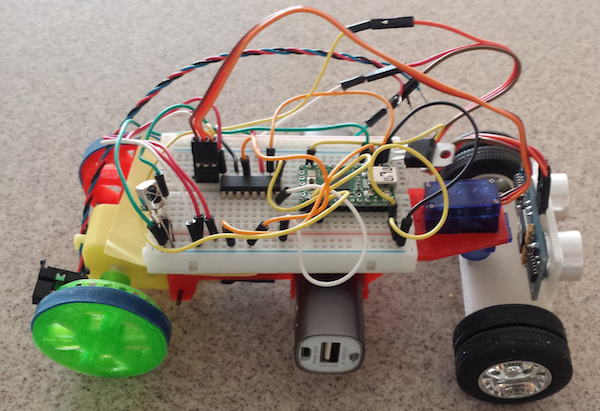
Yes, it’s made mostly out of random parts I had lying around. That’s sort of the point: even if you had to buy all the parts, this thing would be cheap, and if (like me) you accumulate toy and electronic scrap, it’s even cheaper. And any smart kid could put one together. I think the idea started when I found out how much the wheels for those standard gearmotors cost: “Heck, I could print a wheel for that!”

This one has a Teensy 2.0 for a brain, an L293 motor driver chip, a no-name micro servo, sonar, some front wheels off a surplus site, a clearance-sale USB charger from the old Radio Shack, an optical interrupter to read the rear wheels from another surplus site, and a half-size breadboard that provides much of its structural integrity. (Oh, and if you look at the picture carefully you might notice a 7805 voltage regulator in case you want to run your bot off a LiPo battery and get better performance out of the motor.)

I’ve always been vaguely dissatisfied with bots that use two-motor drive for turning, so I came up with this design instead. It’s somewhat less maneuverable, and you have to think a little harder about navigation (pre-calculus, anyone?). But I get simple sonar maps for free, and people who program it get a little practice in controlling servos.

The rear wheels embody some interesting history (for me anyway). My first draft had a reflective sensor that read whether there was a spoke in front of it or not, for an accuracy of about an inch (and a whole lot of analog fiddling to get the thing to read in varying light levels, at slightly varying distances from the wheel, with wheels printed from different materials and so forth). It wasn’t until I’d gained confidence in my 3D printer (and found a logic-level interruptor for a steal somewhere) that I came up with the notion of printing a perforated cylinder. And now I look at it and figure I could probably double the resolution with careful printing.

I hope other people print some of these up, because I really don’t have enough imagination about what to do with them (if you don’t believe me, look at my lousy code). I’d love to see a bunch acting like Braitenberg’s vehicles, for example.

Posted in possibly useful | Tagged , , , | 1 Comment